
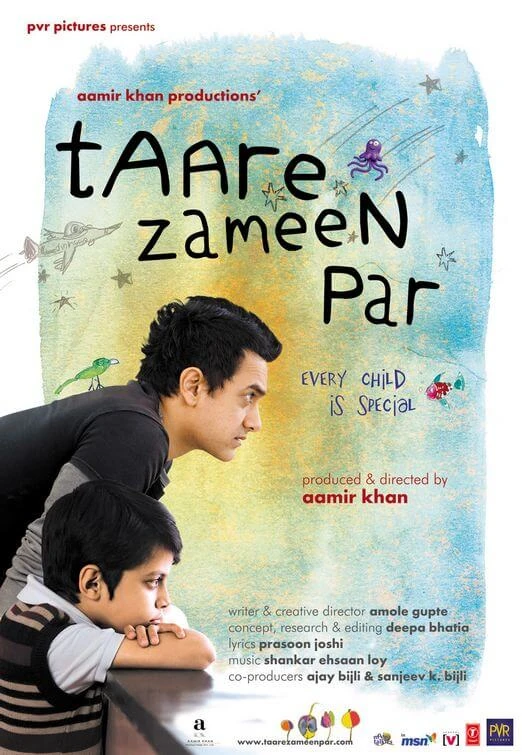
 In this installment of the fabulous fearure series, This Day That 18 Years Subhash K Jha shines the spotlight on Aamir Khan and his wonderful Taare Zameen Par,
Aamir Khan’s Taare trilogy began with the Taare Zameen Par 18 years ago on December 21. He recently rounded of the timeless Trilogy with Sitaron Ke Sitare. In his directorial debut Aamir gives top billing to his juvenile hero Darsheel Safary and happily and comfortably moves into a secondary position.
Aamir Khan is also known to be quite a perfectionist. I’m happy to say his directorial debut, Taare Zameen Par, is not about the perfect shots. For that there is Sanjay Leela Bhansli. Aamir captures all the messiness of childhood , the uncertainties, the anxieties… It’s about getting it right by threshing in the dark. It’s about struggling to find a voice in a wacky and bustling wilderness… Most of all it’s about the lost joys and fugitive innocence of childhood when getting the next sum in your maths copybook seems the biggest struggle in life, when you would rather hold on to your dreams than your over-sized school bags.
Aamir, God bless his sensitive and noble soul, proves a maestro of lucid moving moments….He moistens our eyes and nourishes our souls without working his narrative up into a manipulative lather. Gentle evocative moments glimpsed from the window of the soul irrigate and cultivate the corridors of little Ishaan’s restless mind .
Taare Zameen Par explores the bewildering labyrinth that traps a child’s mind in a state of unfinished ecstacy and enforced anguish.
There have been significant films from India that look at a child’s world from inside, like Satyajit Ray’s underrated Pikoo and Santosh Sivan’s Halo. But if you look at Aamir’s deceptively simple narration, the double vision whereby we see the sensitive child’s cloistered and chaotic world from his perspective as well as from an adult perception, has its roots in Ray’s Pather Panchali.
‘Writer and creative-director’ Amol Gupte brings Ray’s Pather Panchali into the same range of vision as Federico Fellini’s Amarcord and Robert Benigni’s Life Is Beautiful.
Ishaan could be Ray’s Apu from Pather Panchali transposed from the rural idyll of Bengal to the harsh stifling nightmare of Mumbai where the school-bus uploads Ishaan like a perishable commodity. Each day is a struggle. Each morning a fight to get those reluctant feet into the assembly-line…pun intended.
Many of the fringe characters in Ishaan’s school’s staff-room and in his immediate vicinity are deliberately portrayed as cartoonish and caricatural. Aamir knows the fundas of fretful growing-up in and out and applies them with well-oiled wisdom.
Have you seen how adults look while talking down impatiently and condescendingly to a child? Setu’s ceaselessly searching camerawork penetrates the child’s world without puncturing the bubble of the dreamscape that makes a child’s world so precious and preservable. Some of Shankar-Ehsaan-Loy’s remarkable songs and background music concretize the creative clutter in Ishaan’s mind.
Most importantly Taare Zameen Par doesn’t give you a patronizing blue-print on how to bring up a child, specially a ‘difficult’ child.
Sure, it tough being a kid in a grownup’s world. Aamir’s film lets this fact be known through subtle and not so subtle but always sensitive modes of narration. There’re endless shots of under-privileged children captured on candid camera that makes the film unnecessarily self-important.
Couldn’t Aamir have focused on Ishaan’s nucleur world and let it be representative of the larger world of sensitive tenderness?
Hope floats in macro-cosmic dollops in Taare Zameen Par. Now you see Ishaan smilea while. Now you don’t.
But it isn’t easy being a parent either. There’re no clear cut dos and don’ts on parenting. My only objection in this film of enormous virtues is the sanctimonious lecture that Aamir’s character, a modern-day sunny and eminently likeable avatar of Sidney Pottier in To Sir With Love, delivers to Aamir’s rather theatrically-played father in his home.
This deviation from the delectable delicacy of tone adopted by the film, jars. But then Taare… isn’t in pursuit of the perfect voice. Amidst the babble of hysterical and ostensibly rational voices that govern little Ishaan’s world the film finds a scintillating center , a source of primary focus from where all the omissions of Aamir’s vision (why are all the kids in Ishaan’s building so thick-skinned?) appear not only excusable but even perfectly in-sync with the fragile universe that the narrative creates for its little-big hero.
Taare… is a work of multitudinous virtues and some negligible flaws. Most of all it gives us an actor who plays Ishaan with a tender force that sweeps our hearts clean of all cynicism. Playing Ishaan isn’t the cakewalk that it seems. Darsheel Safary had to first get out of his own child’s world and enter this other tormented and splintered world of childhood nightmares and delicate dreams.
Darsheel negotiates that leap from one impressionable stratosphere to another without losing thread of the steps that take him across . I’m sure Aamir’s guidance was invaluable to the boy.
But surely there’s much more to be said about the child’s ability to take instructions so attentively while playing a child who quite simply doesn’t listen to any extraneous voice!
And it isn’t just Darsheel. The other children –Sanchet Engineer who plays Ishaan’s studious elder brother and Tanay Cheda who plays Ishaan’s best friend, plus even the back-benchers in Aamir’s world of comforting confusions —are splendidly sensitive.
Taare Zameen Par is a work of art, a water painting where the colours drip into our hearts, that could easily have fallen into the motions of over-sentimentality. Aamir Khan holds back where he could easily resort to an extravagant display of drama and emotions. He imbues the canvas of the child’s world with colours that portray the pale but prominent shades of life .
A word for Tisca Arora who plays Ishaan’s beleaguered mother. She’s a portrait of maternal sobriety and perfectly in-sync with Aamir’s portrait of restraint. (Come back, Tisca we liked you much better as an actor than director). Aamir’s heart weeps for the loss of childhood innocence along with his eyes. As an actor and a filmmaker Aamir’s sincerity is unimpeachable.
Take a bow, Mr Khan. It takes a load of guts to create a world so free of artifice and manipulation.