
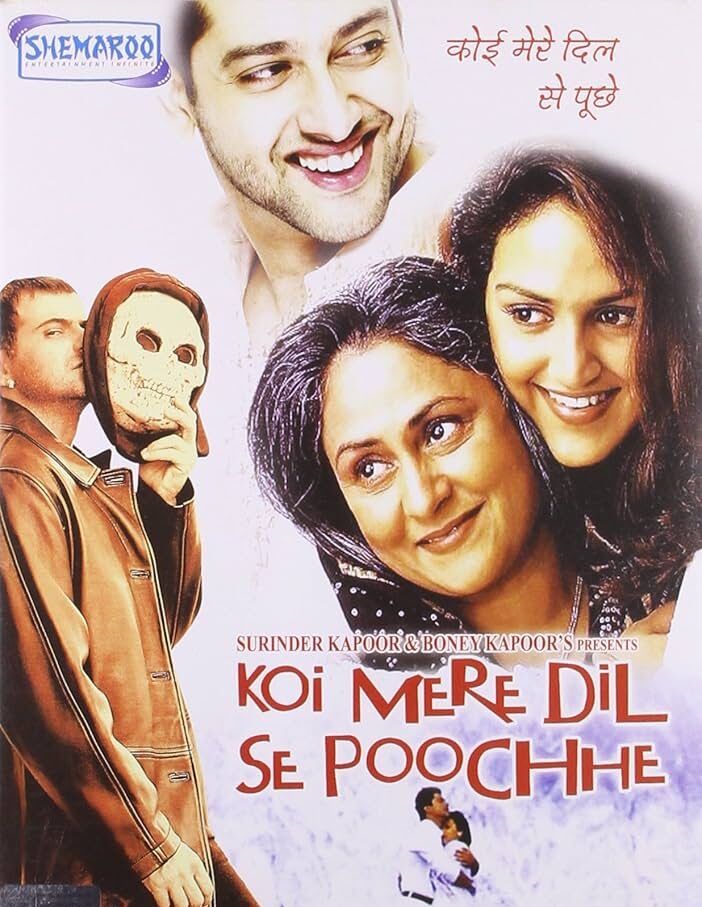
 Subhash K Jha, in a new edition of his series This Day That Year, turns the focus to Jaya Bachchan-Esha Deol’s Koi Mere Dil Se Pooche, which released in 2002.
The mother who once cradled her child to maturity, feeds kheer to her adult son on his birthday. There’s a hitch. The kheer is poisoned. The mother, played with resonant brilliance by the inimitable Jaya Bachchan, wants her son dead so that her traumatized daughter-in-law can rehabilitate her life in peace.
It’s a revolutionary concept, and one that again perpetrates the Mother India prototype of the Mother Earth as the nurturing nourishing entity which can rise in revolt against her own offspring if the social fabric is threatened. Writer-director Vinay Shukla worked on that prototype in his first film Godmother two years ago where Shabana Azmi stood up against her own son’s brutal arrogance and supported and aided a girl’s marriage to the man she loved when the arrogant son insisted on thrusting his unwanted amorous interests on the girl.
Though Koi Mere Dil Se Pooche claims to be a remake of a Telugu film for some curious reason Shukla borrows the basic premise from Godmother in his second film. Koi Mere Dil Se Pooche (KMDSP) begins with Aman (Aftab Shivdasani) wooing the reclusive and diffident Esha(newcomer Esha Deol) through a maze of fetchingly photographed (by Rajen Kothari) locations and ear-pleasing song (tuned by Rajesh Roshan).
The first part of the narrative is designed as a campus romance to seduce the younger moviegoers into appreciative submission. Lavish locales which take us to exotic lakes and stunning seasides and breathtaking aerial shots of the young couple , accentuate their romantic liaison. But do very little to carry the narrative forward.
What KMDSP lacks sorely is fluidity and momentum. In the fashion of the romantic musicals in the 1960s and 70s , Vinay Shukla takes his own sweet time to get to the point. By the time the film’s central character Manasi Devi (Jaya Bachchan) takes charge of the narration, it’s already half-time.
The audience’s restless spirit is somewhat arrested by the dramatic tension of the second-half when Manasi Devi, royally regally and rigidly moralistic, goes all-out to get her scummy son’s presence out of her daughter-like daughter-in-law’s life. The end-game where the mother poisons her own son and perishes in her own anti-matriarchal idealism, is the film’s final and really relevant overture.
Shukla punctuates the heartrending sequence of Manasi feeding poisoned kheer to her evil son on his birthday with montages of the loving mother feeding her child as a baby as a plaintive lullaby plays in the background.
You wish Shukla had given more heart to his narrative instead of succumbing so uneasily (and easily) to youthful seduction. What lifts the film tremendously are the performances. Debutante Esha Deol has been cast in a complex and demanding role that requires her to convey pain and trauma through her silences. It would be grossly unfair to compare Esha with her mother Hema Malini. Suffice it to say that the girl handles her emotional scenes with the seasoned Jaya Bachchan with remarkable sensitivity. Esha is sadly ill-at-ease doing the cavorting-around-the-campus routine. With a bit of grooming and a more polished screenplay Esha should go very far indeed.
Aftab Shivdasani as the besotted young man is surprisingly likeable , although his role requires him to do nothing more substantial than woo the unrelenting Miss through valleys and dales, quite like Sunil Dutt wooed the stoic Vimi in B.R.Chopra’s Hamraaz. But Anupam Kher as Aftab’s father has done the cool-dude dad act once too often since Dilwale Dulhaniya Le Jayenge.
Sanjay Kapoor’s reinvention as the evil intruder is very well projected. The menacing gait, the closely cropped hair, the wicked half-smirk-half-smile and a blood-splattered skeletal mask , all enhance Kapoor who has worked into his role with gusto. The audience roars with relish when the evil Dushyant barges into Esha’s engagement with Aman to break into a song and dance. When will our filmmakers cease to glamorize evil?
It’s Jaya Bachchan who stands tall stately and supreme in the narrative. Though director Shukla hems and haws before getting to her core character, Jaya splits the screen open with her expressions of agonized motherhood in the second–half. As she goes through the emotions of playing mother to her daughter-in-law we ‘re gently reminded of the widowed Jaya in Sholay who’s encouraged by her father-in-law to remarry. Reminding us of her heydays in Hrishikesh Mukherjee and Gulzar’s cinema, Jaya gives her best performance in recent years in this film of mixed merits.
While on one hand you applaud the director for making a non-conventional love story, you sporadically find the difference careening into indifference. The comedy track spoofing Aditya Chopra’s Mohabbatein with comedian Jaspal Bhatti and Rajpal Yadav playing Amitabh Bachchan and Shah Rukh Khan , is amusing for a while but soon gets in the way of the narration.
The same is true of the director’s efforts to present the eagerly awaited debutant Esha Deol in bright flattering shades. Though Vinay Shukla succeeds in creating a positive aura for the newcomer , this isn’t a film that brooked any pre-conceived agenda.
Like Manasi Devi who stands up for what’s right even if it means going against her own son, director Vinay Shukla needed to concentrate on doing what’s right for his film rather than ensure a safe debut journey for Esha Deol. But then as Manasi Devi would have said if she had lived after poisoning her son, someone had to the job.