

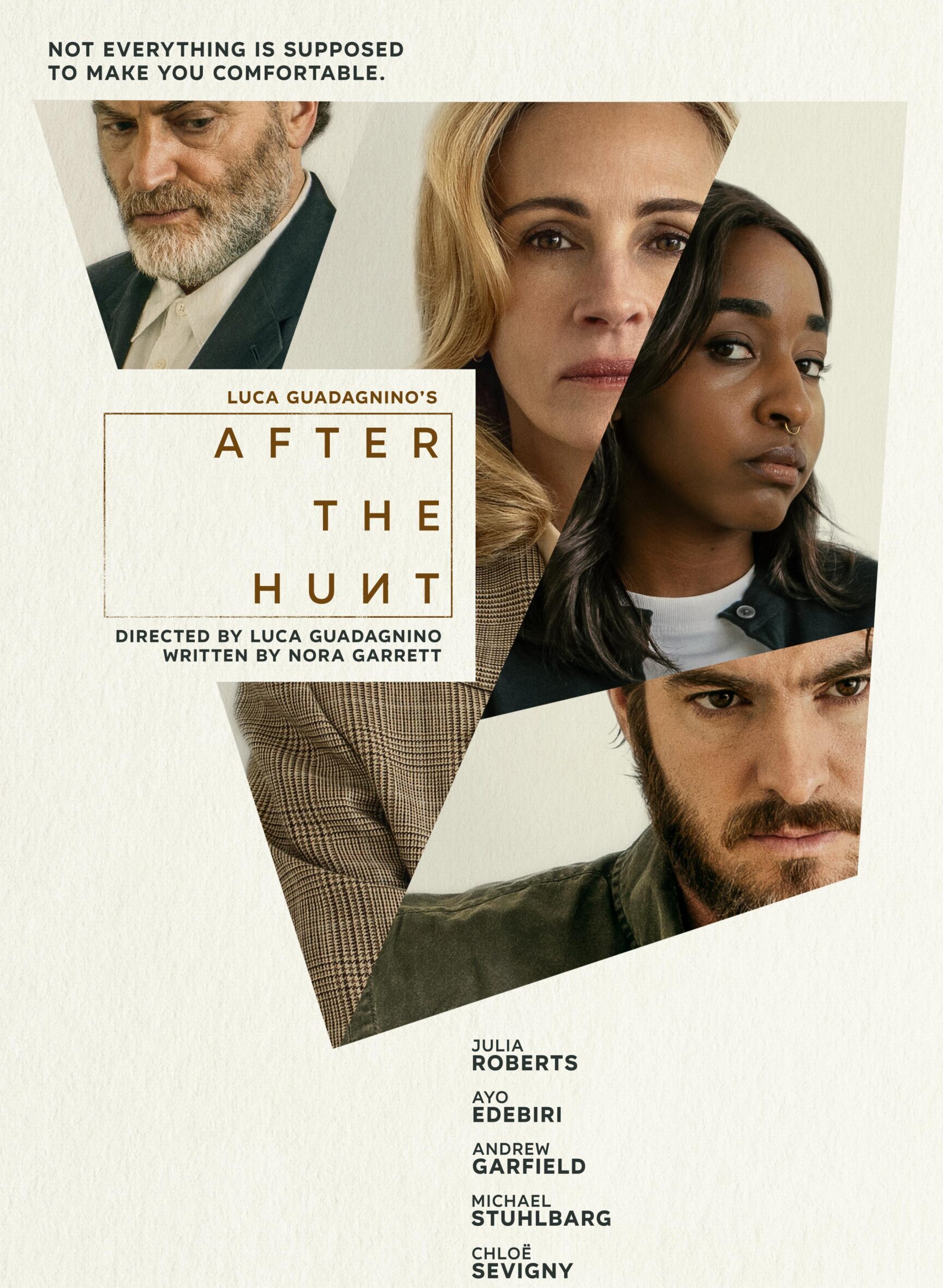
 Let me confess, I’m a fan of Julia Roberts. Who isn’t? She is smart, sexy, vivacious, deep, and enticing. This film, sadly, is none of these. Not that it lacks an intellectual heft. Perhaps there is too much focus here on the amorous activities of the academia, and too little on the dilemma of a woman who must protect a protegee/friend who claims she has been assaulted by a professor.
After The Hunt begins one languorous evening with the endless intellectual prattle among academicians of all shapes sizes and colours as they huddle in a cerebral haze of alcohol and appertifs at the plush home of Alma Imhoff(Julie Roberts) and her husband Frederik , played by the mutely brilliant Michael Stuhlbarg (he played Timothee Chalamet’s supportive father in the same director’s far superior Call Me By Your Name). A quietly efficient homemaker/psychiatrist who potters around making himself useful to his wife’s guest
Director Luca Guadagnino’s film is a world untainted by visual glitches. His characters are immaculate in their behaviour, in the way they hold their glasses, shuffle their thoughts, and swivel their memories. I am not sure this heady cocktail of crypticism and evasion works here.
In After The Hunt Julia Roberts as the woman hurled into a moral conundrum, holds back too much to reveal what her character really feels. The most “revealing” performance comes from the alleged assaulter, Henrik(Andrew Garfield) who is not so much horrified by what seems to be a misconstrued situation, than by the lack of support from his friend Alma who seems to be pushing herself into believing in Henrik’s guilt because that is expected of her.
Much of what we feel during the course of the film is tenebrous. We can’t rely on our responses to what we see on screen. Luca Guadagnino won’t let us. He doesn’t want his audience to get comfortable either way: in accepting or rejecting Henrik’s guilt.
Henrik is privileged, arrogant, insufferable, and well played by Garfield. The assault victim Maggie (Ayo Edebiri) is unreliable. In the beginning we see her snooping around in Alma’s bathroom cupboards. Some time later she comes sobbing to Alma about the assault. Is she really the victim she portrays herself to be?
Finally, it doesn’t really matter. This is not a film that is interested in conclusive answers to the very complex questions of consent and assault. We come away from After The Hunt feeling an uneasy numbness, which probably the director wanted us to feel. But we are not sure if that’s what we wanted to feel.
Finally Julia Roberts’ Alma gets to collapse in the middle of her educational campus and confess from the hospital bed that she had once accused her much-older lover of sexual assault when he ended their relationship.
What do we make of this?