
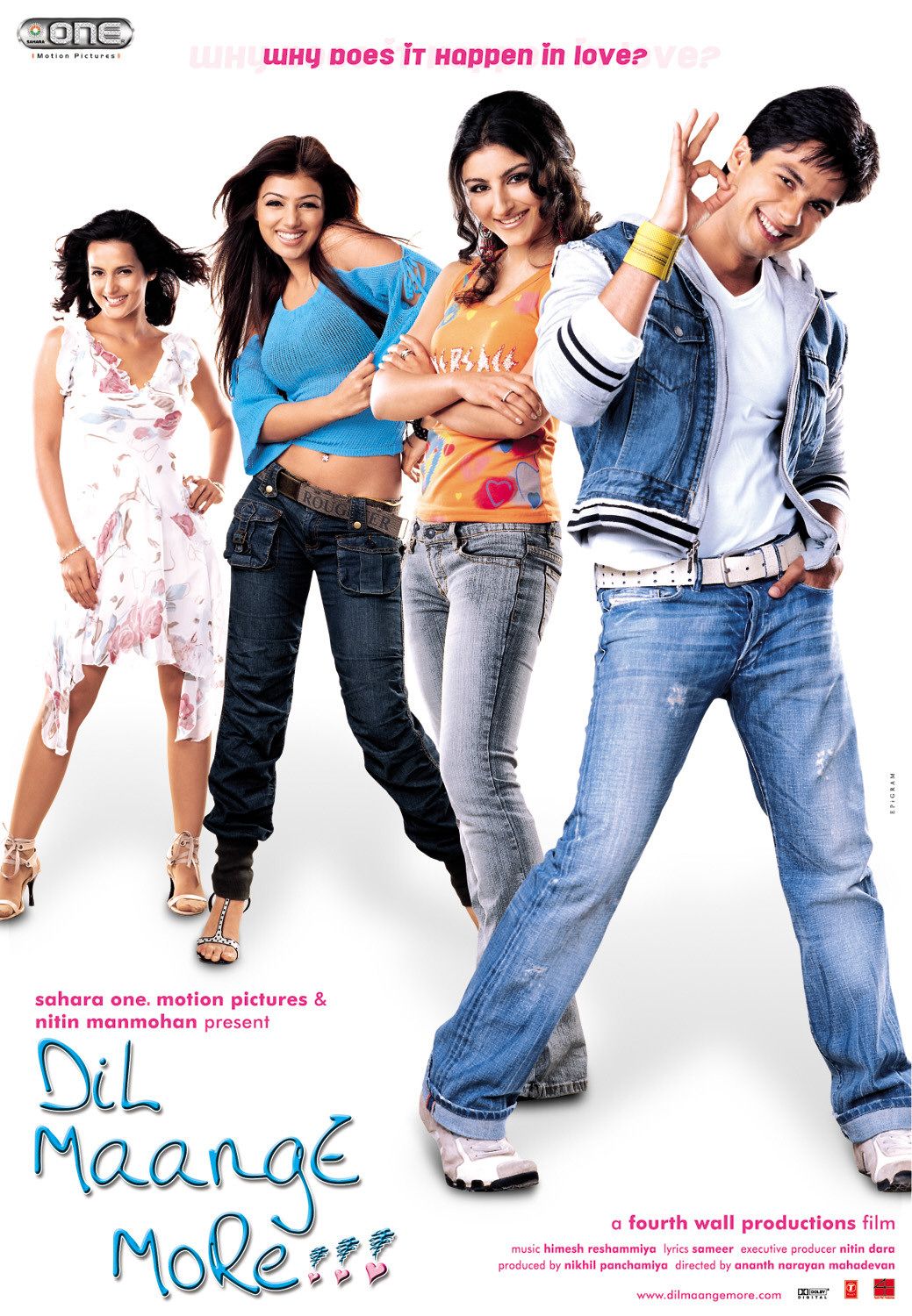
 Subhash K Jha takes a look back at Ananth Mahadeven’s 2004 rom-com, Dil Maange More, that starred the fab cast of Shahid Kapoor, Ayesha Takia, Tulip Joshi, and Soha Ali Khan in her film debut.
Happily in Ananth Narayan Mahadevan’s full-fledged romantic comedy there isn’t much room for tears. Moving many steps above his decent directorial debut in Dil Vil Pyar Pyar, Mahadevan gives us at year-end the first and only real romantic comedy of 2004.
Dil Maange More isn’t great cinema. But it’s funny, sassy, sweet, tender and intelligent. That’s a lot more than what we get in most of the cheesy love stories about girls in short skirts and guys with eternally enhanced libidos.
Playing the most likable small-town guy since Aamir Khan in Raja Hindustani, Shahid Kapoor gives the film an endearing spin as Nikhil Mathur from an imaginary hill resort named Samarpur who follows his dreamer-girlfriend Neha (Soha Ali Khan) to Mumbai and gets into a bizarre but never corny or sleazy, quadrangle .
Faintly reminiscent of the 1960s Dev Anand starrer Teen Deviyaan, Dil Maange More is a lot more clever and articulate than the genre would suggest. Mahadevan constructs a wispy pyramid of postcard-pretty pictures where the people actually appear real. The Indian hill station is an idyllic haven shot at an alpine location. Thanks to Amit Roy’s smoothly-scenic cinematography and Mansi Mehta’s tastefully touristic art work the characters are never reduced to poseurs in paradise.
There’s a constant flow of delectable dialogues, filled with puns and other clever pangs which make the characters appear more filled-out and complete than they generally do in blithe romantic musicals in our country. Besides the utterly winsome protagonist, the music-shop owner A R Rahman (Gulshan Grover) is also a likeable creation.
The small-towners bonding with his boss and with his bellicose neighbour Shagun’s (Ayesha Takia) Gujarati mother (Zarina Wahan) implants a certain moistness to the cut-and-dried theme of one guy sandwiched among three demanding and exasperatingly unpredictable women.
Thanks to the cool and crisp narration , and of course Kapoor’s author-backed performance we never tire of the film. Mahadevan’s above-average aesthetic sense surfaces in improbable ways. Nostalgic music and songs played a big part in his first film. So it is here as well. The songs and voice of Mohd Rafi are a recurrent and eminently engaging motif. Shahid’s character encompasses a genre-defining zest for the past and present.
A lot of the best scenes are played out at a music store bustling with song-talk. And when Mahadevan takes the narrative to the dance floor or the scenic location for the lovers to emote and dance to Himesh Reshammiya’s ‘original’ tunes, we aren’t distracted at all .
There’s music in the soul of this film. It may not be discernible right away , as the film’s theme and characters swim in shallow waters. But to mistake the characters’ trivial Valentinian pursuits as signs of superficial filmmaking is to confuse the lyrics with the quality of singing.
Mahadevan takes these flighty fidgety young characters beyond their positions in the plot . In this endeavour he’s constantly aided by his leading man. Shahid Kapoor’s grasp over the grammar of romantic comicality is astounding. His spot-on timing and extraordinarily fluent dance movements make him a very engaging entertainer. Watch Shahid in the sequence where the khichdi he cooks blows up in his face. Here’s one new actor who can cook up a khichdi without the calamitous consequences that have become part of films about the activities of the young.
Among the three girls, Ayesha Takia as the spirited girl nextdoor gets maxium space and makes optimum impact. The eagerly awaited debutante Soha Ali Khan has a long way to go before she justifies her genetic advantage as Sharmila Tagore’s daughter.
Gulshan Grover is excellent as the leading man’s cool-dude boss. But the film’s ‘climax’ on-board a cruiser is a bit of a damp squib. Surely Mahadevan could have thought of a less unwieldy way of resolving Nikhil Mathur’s heart problems? But let’s not crib. Let’s applaud a film that goes into frivolous lives without getting frivolous or vulgar.
Speaking of his directorial debut Ananth Mahadeven realls, “I wanted to make an irreverent romantic comedy. The thought that you never end up marrying your first crush and that someone else may be destined for you, is the plot of the film. Shahid Kapoor, whom I knew from his toddler days had just burst into the scene and was the ideal choice for the lover boy driven by confusion in his romantic trysts. Producers Nitin Manmohan and Nikhil Panchamiya came on board. We were looking at three fresh female leads and Soha Ali Khan ended up making her debut . Tulip Joshi and the winsome Ayesha Takia completed the trilogy. Shahid was a rare picture of energy and his dances were electric in the film. Himmesh’s score turned out to be his best with songs like ‘Gustakh dil’ becoming a rage. We shot in Malaysia and Goa to give the film its visual expanse. It all fell together very cutely. The colors, the moods , the performances.”
Ananth says Shahid and he were targeted for hate campaign. “For some strange reason I was shocked to see a media backlash against the film when it was released. Coming from some people at the helm whom I knew, this was definitely prejudice. It did dent the film’s prospects, though. Eventually every channel ended up showing it at least once a month, turning it into a cult date-film. But a successful box office run could have been achieved too with some support from the media and industry soothsayers, which was grudgingly withheld. That the film still lives on in memory is statement enough, I guess. Maybe your article can repair the damage that didn’t allow the film to perform to its full potential. Shahid and I were targeted for a hate campaign.”