
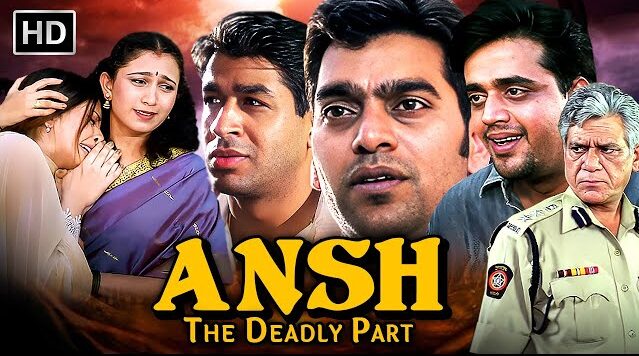
 Subhash K Jha revisits Ansh: The Deadly Part as it completes 24 years.
Don’t groan. Yet another film depicting the murky nexus between Mumbai’s underworld and Indian politics? Do we really want to see another film on gangsterism after Company? The answer is an emphatic yes, provided the film is as well-intended, thought-provoking, and sporadically moving as Ansh.
Let’s get one thing straight. Ansh isn’t by any yardstick, an outstanding piece of cinema. Besides revelling in a state of idealized self righteousness, it suffers from an overdose of characters and dialogue. The technique applied to the storytelling is at best, passable and at worst, clumsy, and embarrassing. Also, Ansh suffers from thematic fatigue. It comes a bit too late, after we have seen a spate of blood-splattered gangster films cluminating in the stunning Company.
Having said all this Ansh still remains an important film for the message second-time director Rajen Johri puts across with a lack of finesse that’s indicative of his raw, smarting anger at the shoddy state of the nation. Johri’s plot is audaciously ambitious, packed with hard-hitting jabs at politicians who are blamed for every malady in our social hiearchy. In fact one of the crooked neta even turns around and says, “Politicians are the biggest goondas of the country.” Touche!
Ironically, the sequences showing the sleazy hobnobbings of the politicians are the most the most clumsily conceived interludes of the film. Milind Gunaji, Shayaji Shinde, Irshat Ali. Yunuz Parvez and , ahem , gang who play seedy corrupt politicians ham to the hilt. Surely a little more subtlety should have gone into the execution of the political power games and in depicting the criminalization of politics.
But then you realize Johri is angry, very angry , at what politicians have done to the country in the last 50 years. As the freedom fighter, played by Alok Nath says, “We fought the Britishers for 200 years to get independence for the country, only to have India fall into the hands of undesirable politicians.”
We gradually begin to empathize with the film’s urgent plea for social reform as represented by the three protagonists. Bhagat Pandey (Om Puri) is an honest officer who insists on working from within the social system eventhough all his attempts at eradicating crime and corruption are thwarted by opportunistic elements.
In contrast, there’s Sukhdev Singh (Ashutosh Rana) a disillusioned, throughly disgusted cop who goes around shooting the scum of the earth in endless “encounters” until he’s suspended for over-zealous execution of his duties. In sheer disgust, Sukhdev switches sides , becomes an outlaw, crowns himself “the only don of the underworld” and takes on the festering system headlong.
Raj Guru (Tamil star Abbas) is the face of innocence forced to take to the gun by joblessness, persecution, and injustice. When after Raj is unfairly slapped around by a cop , Sukhdev Singh apologizes. “That’s okay. We the poor are destined to be kicked around,” Raj ‘s words make a hole in our hearts.
Just how these three modern-day freedom fighters, the neo-Bhagat Singh and his deputies, come together to undertake an instant social-cleansing exercise forms the core of Johri’s exposition on oppression and extremism.
There are powerful moments of exploration in the narration which make us think hard. When the drunken suspended cop (Ravi Kissan) tells the extortion-threatened film producer that subjugation and fear are an essential and inescapable part of the Indian sensibility, we cringe.
Johri often lashes out at places too close to home for comfort. His stark home truths originate to a large extent from Govind Nihalani’s Ardh Satya. The character of the sozzled ex-cop is almost a tribute to Naseeruddin Shah in Nihalani’s film. And the elating finale when the three heroes are hanged in public, a la Bhagat Singh and his associates is a curious amalgamation of history and fiction that works on a very basic level.
What’s completely unacceptable are the broad concessions to fascism. The way Sukhdev, Bhagat, and Raj spray bullets into politicians is an alarmingly over-the-top metaphor for social injustice. If we need to take to the gun to smother corruption then we might as well reconcile ourselves to living with the laws of the jungle.
What finally makes us overlook the film’s clumsy idealism are the performances. Om Puri and Ashutosh Rana, specially the latter, bring a sense of immense pain and anger to their representational roles. Rana is specially outstanding when on the steps of the court he declares to Puri why he’d fight from outside the leagl system , or when he reminds Puri that all he has to show for his years of honest service are a series of transfer orders .
The third most moving performance comes from Ashish Vidyarthi who as the benign gangster who godfathers Raj Guru, controls his tendency to ham and delivers his best performance in ages. The way Vidyarthi reconstructs his innocent past and his slide into gangsterism are so vivid, we don’t miss a visual flashback. Abbas as Raj Guru is aptly innocent in his demeanour. But the two ladies Sharbani Mukherjee and newcomer Shama Sikandar (the only two notable female characters) are major distractions.
Though the music by Nadeem-Shravan is soothing it really has no place in this film. Sharbani Mukherjee three dance items should have been left out of the plot. They’re too exploitative to be part about a film that argues so passionately against socio-political injustice.