
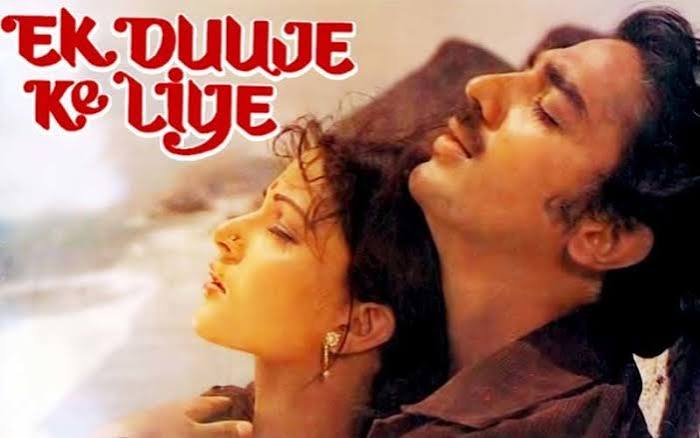
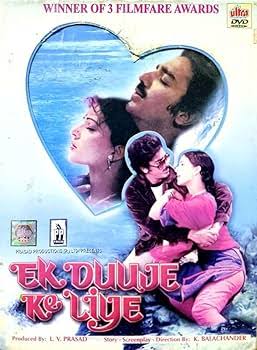
 After K. Balachander’s inauspicious debut in Hindi cinema with the well-intended Aaina (which he remade from his Tamil hit Arangetram) the doyen of the South Indian cinema bounced back with one of the biggest musical romances of the Hindi cinema. Ek Duuje Ke Liye, released in June 5, 1981, was a grand musical hit.
The story of a Tamil boy and the Punjabi girl who communicate through Laxmikant-Pyarelal’s universal language of love, was so endearingly suffused with moments of romance, it couldn’t have failed.
And it didn’t. Ek Duuje Ke Liyewas one of the biggest successes of the 1980s, setting a pattern for future romances between mature 20-something lovers as an alternative to the teenybopper togetherness celebrated in Raj Kapoor’s Bobby and its innumerable spinoffs. Kamal Haasan was hugely entertaining as the prankish Tamilian. Spinning tops on the giggly Rati Agnihotri’s jelly belly and shrugging his shoulders to her shuddh Anand Bakshi-penned lines ‘Hum bane tum bane ek duuje ke liye’ with the cutely Tamilian English retort, “I don’t know what you say. But I want to dance and sing.”
Kamal Haasan sang and danced into Hindi moviegoers’ hearts. And Rati followed right behind. It’s hard to believe that the media pitched the made-for-each-other pair against each other. Kamal denies any differences with his co-star during the making of the film. It was only after the release of the blockbuster when Rati spoke against director K. Balachander that Kamal loyally flared up on his mentor’s behalf. Kamal and Rati did another film, Dekha Pyar Tumhara, which could have been a gem but was stymied by the lead pair’s personal differences.
Ek Duuje Ke Liye with its haunting Goan locales and Lata Mangeshkar and S.P. Balasubramaniam’s raga-driven voices suggested a depth and feeling beyond the superficial romances of Indian cinema. Songs like ‘Tere mere beech mein kaisa hai yeh bandhan anjaana’ and ‘Solah baras ki baali umar ko salaam’ made the onscreen lovers look mature, passionate, and simply unforgettable. The tragic doom-laden finale, whereby the lovers committed suicide, triggered off a chain of self-annihilating love stories in the South. Balachander was advised to change his screenplay. But he stuck to the original ending.
The original film in Telugu, Maro Charithra, was a Tamil-Telugu love story. Wisely Balachander transposed it to a Tamil-Punjabi terrain for the Hindi version, with the humour and situations from the original preserved to the core. The film marked a joyous beginning in Hindi cinema for many artistes, including Kamal Haasan, Rati Agnihotri, and Madhavi, who played the widow with a soft corner for the restless Balu (Kamal).
 .
.
The Doyen of the South, L.V. Prasad, himself a director of awesome stature, produced Ek Duuje Ke Liye for Balachander. The love scenes in Ek Duuje Ke Liye such as the one when Balu sings a whole song based on mukhdas of Hindi film songs to Sapna(Rati) in a lift, or when Sapna burns Balu’s photograph and defiantly drinks the ashes with her coffee in front of her hysterical mother(Shubha Khote) were symptoms of a passion never before seen in Hindi cinema, except perhaps in Raj Kapoor’s Awaara.
Balachander made two other extremely thought-provoking Hindi films Ek Nayi Paheli and Zarasi Zindagi with Kamal Haasan in the lead. Neither worked even a fraction of the magic of Ek Duuje Ke Liye at the boxoffice. The very idea of a couple being asked by their respective parents for a trial separation of one year fired the romantic imagination of the viewers.
Thanks to Laxmikant-Pyarelal’s music and Anand Bakshi’s poetry, the couple seemed to communicate by telepathy. From Laila Majnu to Bobby-Raja (in Bobby), we had seen screen lovers do everything conceivable and inconceivable for each other. But we had never seen anyone quite like Balu and Sapna.
Ek Duuje Ke Liye competed with two Bachchan biggies, Naseeb and Satte Pe Satta, and still emerged as the top money-maker of 1981.
Interestingly, the film’s producer L.V.Prasad was persuaded to co-star with Kamal Haasan in the Tamil film Raja Parvai during the same year that Kamal made his Hindi –cinema debut in Ek Duuje Ke Liye.
Recalls Kamal Haasan, “Balachander Saab was my guru and mentor. I could never look into his eyes. I had too much respect for him.”