
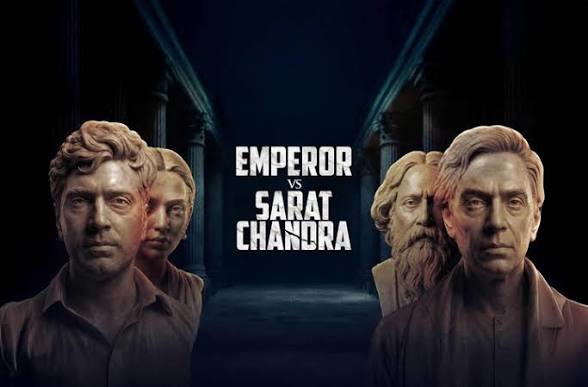
 There are so many questions that the super-prolific Srijit Mukherjee’s new Bengali film leaves unanswered. What if the luminous litterateur Sarat Chandra Chatterjee met his idol Rabindra Tagore for a one-to-one where the idol falls from grace with a thud that impacts many more than just those we see on screen?
Srijit’s ambitious tale subsumes a plethora of characters from history and literature: Sarat Chandra of course, played by that chameleon of an actor Tota Roy Chowdhury who disappears into his character (conversations punctuated by a smoker’s cough and all) so fluently that I wondered how the actor found his way back to his real self.
While Srijit’s Sarat Chandra battles creative and political demons, his character from his novella Pather Dabi , Sabyasachi Mallick (Abir Chatterjee, delectably disguised and militant) makes life a little difficult for the Britishers. A full-on revolutionary, Mallick is a vigorous specimen of salvation. Sadly, he is a figment of Sarat Babu’s imagination. But what if he was real? What if he was reborn as Abhijeet Dipke?
Srijit’s film moves ambitiously and mysteriously in two dimensions: there is Sarat Chandra obstinately dodging colonial intervention, and then there is Sarat Babu’s character Sabysachi and his comrades huddled in a rebellious circle .
I am not too sure the film-within-film format works for the characters. Wouldn’t the two tracks have worked better in two separate films? That said, the audacity of the endeavour (when has Srijit ever been anything less than audacious?) is admirable, especially since this Sarat Chandra saga doesn’t have the budget of Sanjay Leela Bhansali.
Rather than lean into luscious lavishness, Srijit concentrates on authenticity. The homes echo the period (late 18th century-early 19th century) with a nostalgic vigour. The crowd scenes give away the budgetary constraints. Wisely the narrative focusses on the characters, capturing them in a state of turmoil and transition without tripping over the timelines.
Indranath Marick’s cinematography is profoundly introspective , searching out the mindsets of the rebellious anti-colonial characters not so much in their externalities as somewhere deeper. Srijit Mukherjee interiorizes the struggles of the characters, letting us scarcely get a peep into their turbulent souls.
Besides Sarat Chandra, the other protagonist, Sabyasachi Mallick, represents the calm before the storm. Abir Chatterjee’s various disguises to hoodwink the Brits are a yarn in themselves. His disguise as the Oriya Girish Mahapatra is notably delightful.
Propitiously the supporting cast is uniformly engaging. Sanjoy Nag as Tagore imparts a much-needed gravitas to the role. In the key sequence where he defends the Britishers, his voice conveys the pragmatism of a sold-out seer.
Mimi Chakraborty as Sabysachi’s muted love interest Sumitra gets limited time. She makes a feast of it.She is fiery and yet so feminine.
The film finally belongs to Tota’s Sarat Chandra and Abir’s Sabyasachi. Of course they never come together. This is The French Lieutenant’s Woman without the actors ever meeting their creator.
I wish Srijit had avoided some excesses in the dual storytelling. Koushani Mukherjee’s Mujra as Chandramukhi seems unnecessarily self-indulgent,although the music and songs(by the director, turning music composer for the first time) feel organic.
One last thought: it would be impossible to make The Emperor Versus Sarat Chandra in Hindi. Bollywood no longer has classic faces, except maybe Deepika Padukone, who can play Sumitra effortlessly.