
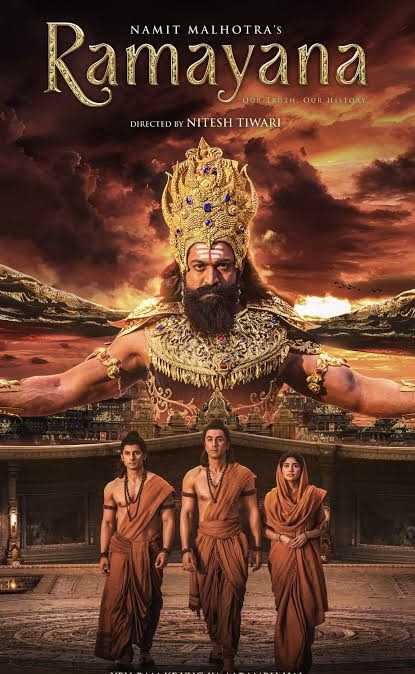
Let’s cut to the chase. Nitesh Tiwari’s Ramayana Part 1 is a monumental achievement. The film is spectacular to look at, with some of the most visually vibrant episodes hyperstrung together, almost as though Valmiki had personally blessed the project and given the makers of this version of his timeless work the right to innovate, extend, and amplify the original poem into a contemporary masterpiece.
Which Ramayana Part 1 is.
Almost. It misses the ‘burst’ for its palpable lack of emotional heft to match its exceptional visual vibrancy. There is more chemistry between Rama and Laxman than there is between Rama and Sita. Of course, we get the scriptural constraints of portraying a mythologicized spousal bonding. But seriously, Ranbir Kapoor and Sai Pallavi look like they have just met while travelling together to Ayodhya.
In one rather unexpected burst of spousal love, Ranbir’s Rama confesses to Sita, “After meeting you, I don’t feel like looking at any woman.”
This sounds more like what Ranbir must have told Alia Bhatt while proposing to her.
The Surpnakha episode is one of the rare non-happening plot propulsions in a narrative that holds us spellbound almost to the end. Rakul Preet Singh looks and behaves like a woman of today. Maybe that’s what they mean by timeless.
There are times when I felt like asking the co-writers, Shridhar Raghavan and Nitesh Tiwari, to slow down, give the characters a chance to breathe easily.
Then there were times when the characters felt a somewhat lost, especially Ranbir Kapoor’s Rama and Sai Pallavi’s Sita which are drawn out of pure empathy and unquestionable reverence, but somehow they feel like what the Rama-Sita jodi should be, rather than what they are.
The idealization of the Rama-Sita jodi comes in the way of their spontaneity.
The supporting cast, especially Ravi Dubey as a playful, impetuous Laxman and Arun Govil as a tragic Shakespearean Dashrath, are first-rate. But every actor and character—and none more so than Kajal Aggarwal’s Mandodarai, Kunal Kapoor’s Indra and Adinath Kothare’s Bharat—acquires a distressing haziness when compared with Yash’s Raavan, a flawed, scholarly, stubborn and arrogant villain who fights and kills his own brother-in-law (Vivek Oberoi) for insulting the family, a la Sunny Corleone in The Godfather, and who attains a timeless spirit of self-assertion in Yash’s spectacular performance.
I don’t know whether this is a flaw, and a fatal one at that, But Yash’s Raavan is not only larger than life, it is sizes larger than the narrative itself. The first twenty minutes or so is devoted to establishing Raavan’s character, right from the scratch. His combat with his brother-in-law also seems ceaselessly stretched out.
But honestly, we don’t mind. Yash’s Raavan performance is pure gold, in keeping with the Sri Lankan architecture.
Ramayana Part 1 is absolutely spectacular to look like, without the archictectural splendour becoming rococo. Production designers and art directors Ramsey Avery, Ravi Bansal, Subrata Chakraborty, and Sayalii Naikwadii, David Lazan and Kathy Heaser, Baban Adagale, Ramesh Andhale, Kedar Jangam, Uttam Mondal, Dikshant Soni, Swapnil Tawde are the real heroes of this smashing Ramayan re-dux.
After Yash, of course.
Pankaj Kumar and Mahesh Limaye’s cinematography is comparable with anything we have seen in Christopher Nolan or the Marvel movies. The forests, the palaces, the weddings, and the combats are created with an enrapturing aestheticism.
The fight with the monsters in the jungle is as riveting as its equivalent in Odyssey. Visually, Ramayana Part 1 is nearly flawless. The frames are impeccably shaped, tilting far enough to skirt immortality. If only the emotional scale could match the visual splendour.
This is cinema as it was meant to be. Freed of Dhurandhar’s sanguinary malevolence, Ramayana Part 1 reclaims Rama Rajya with authority and finesse.