

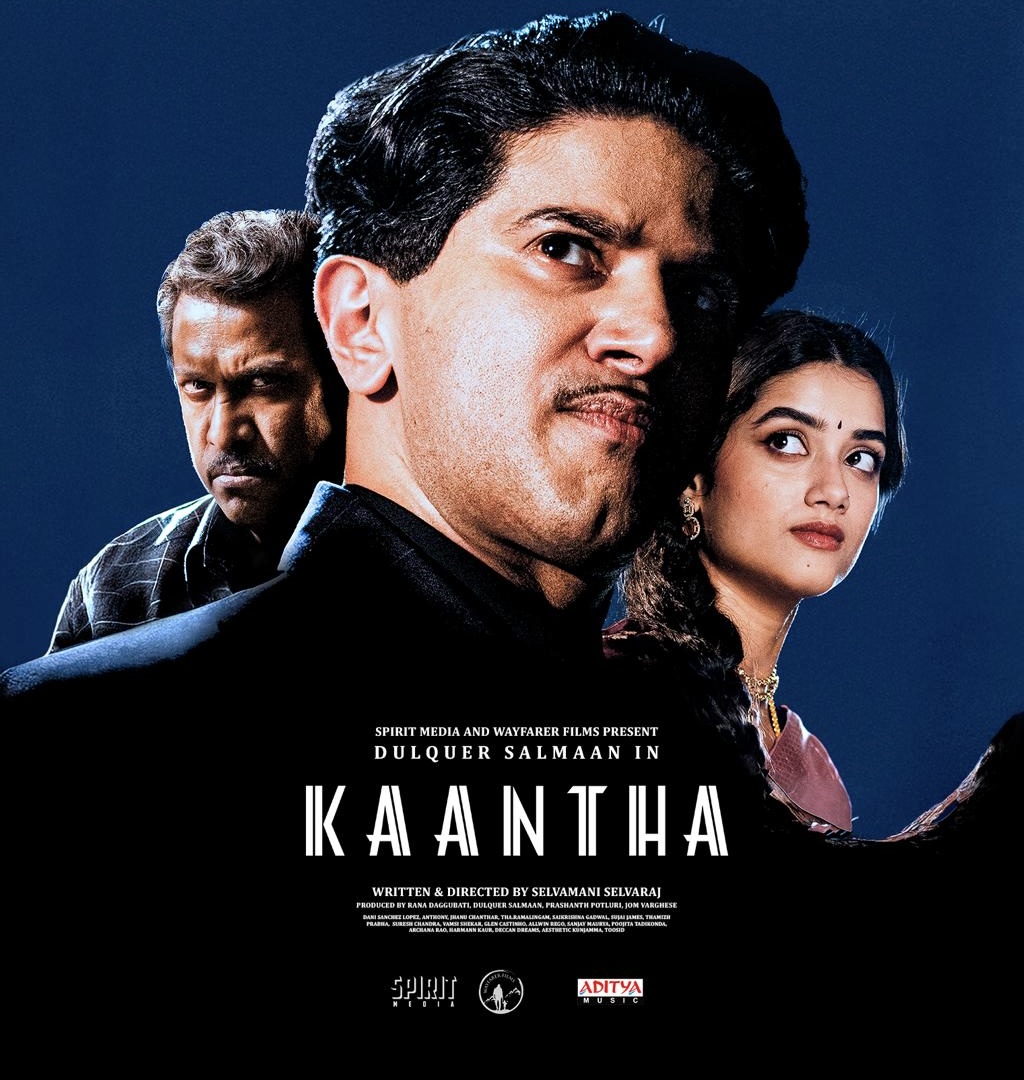
 Playing an actor from the 1950s in this Tamil turkey, Dulquer Salmaan is supposed to do a lot of hammy acting while the camera rolls in the film within a film. Camera consciousness attains an all-new definition in Kaantha.
Dulquer has never been an actor capable of bringing variety to his performance. To manage two levels of performances in one film is clearly not his scene. He struggles to show us actor T K Mahadevan’s arrogant disregard for his mentor filmmaker Ayya (Samuthirakani)’s feelings, even as Dulquer Salmaan the actor playing Mahadevan, struggles to show us the theatrical performances of those times as Mahadevan shoots for a film called Kantha.
A film within a film is a format that Meryl Streep attempted so magnificently in The French Lieutenant’s Woman. Dulquer fails both as an actor portraying an actor, and as a character acting in a do-or-die make-or-break film. Mahadevan’s emotive excesses in a death scene, cannot be explained by Dulquer’s understanding of actor reactions in the 1950s.
There is much less here than meets the eye.
Egos fly high (but not too high, as the ceilings are head-bumpily low) on the set, as Mahadevan tries to take over the shooting from the mentor-director. Sandwiched daintily between the two male egos of her mentor (turned tormentor) and lover-hero, is the film’s heroine Kumari played by Bhagyashree Borse, all decked up as a 1950’s heartbreaker in a performance—and a film—which is more fashion than passion.
There is no dearth of ambition in Kaantha. The director, Selvamani Selvaraj, pans confidently across three unreal lives which are lived through mirror images . Cinema is an illusion. And the three main characters, the actor, director and heroine , fail to make their lives more interesting than they actually are. Kantha suffers from an overdose of selfimportance. It , and its leading man(who clearly wants to flatter himself , only to deceive ) are constantly posing even when the camera within the film on the sets is not rolling.
There is the additional problem of Samuthirakani being a far better performer that Dulquer. The two seem so mismatched in their histrionic calibre, it feels like a conflict of interest, far beyond what we are watching.
The mid-point is the decisive section where the narrative bifurcates into two halves. While the first half at least displayed a modicum of intuitive elegance the second half turns into a murder mystery(with no mystery except the one about why the screenplay was converted from one religion into another). Rana Daggubati investigating the murder is so taken up with his own swag that it feels like a man who keeps gazing into an invisible mirror all the time.
By the time Kantha arrived at its final ‘twist’, I couldn’t care less what happened to the characters. Stilted rather than sumptuous, brocade rather than silk, this is a film of overweening aspirations and underwhelming ramifications.