

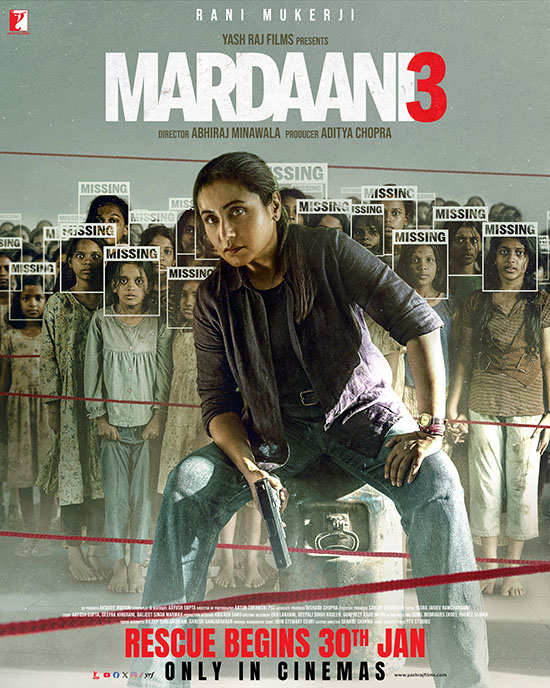
 If Aditya Chopra wants to franchise his wife Rani Mukerji’s histrionic muscles, it is understandable. But could he please find a less disagreeable way of showcasing the talented Mukerji’s personality than a tired, overused franchise?
Why three films about female child trafficking? There are other methods of human torture, films such as this being one of them. Mardaani 3 is in gross violation of all definitions of aesthetic cinema.
After watching little girls being traumatized for more than two hours, I wondered how the parents of these young actors allow them to be subjected to this nauseating indignity.
The film’s makers, including director Abhiraj Minawala and the trio of writers Aayush Gupta, Deepak Kingrani, and Baljeet Singh Marwah, seem to be given a single brief: make Rani Mukerji look like a true Shero, and to hell with the screenplay, which jumps from one adrenaline-sponsored dhamaka to another, caring little for the other characters.
Mardaani 3 starts with a clumsily staged fight between the Shero and the goons. The entire buildup of Ms Mukerji’s introduction is staged like the entry scenes of the heroes in the 1980s, some of them produced by, ahem, Yash Raj films.
There are two villains in Mardaani 3 (not counting the ubiquitous villain, tedium). We will focus on the female antagonist nicknamed Amma (as naming the other villain would be a spoiler) and played by actress Mallika Prasad as the cartoon version of Videogame Menace. She is loud and boorish and doesn’t think twice before slaying victims of all ages. But somehow she isn’t scary.
She is Mogambo with a blood-wish and a cackle that could wake up toddlers and octogenarians alike. She is as scary as neighbourhood aunt who shoos off kids playing in front of her house.
There is another villain who is revealed to be one midway, although anyone who has watched Hindi cinema for as long as I have would know his intentions from the start.
The writing very clearly wants to be unpredictable. But deliberate manufactured jump-shocks and agitated editing cannot compensate for inspiration which the screenplay truly lacks. While Rani reveals flashes of her renowned talent here and there, she comes across largely as trying to be the best version of her character Shivani Shivaji Roy , and failing because… well, there is so much work to be done.
Rani’s character is cluttered with baggage that we never get to see. Her husband, played by a known Bengali actor Jissu Sengupta, is barely a shadow in this futile exercise of Shero-glorification. A female cop colleague, a rookie named Fatima (Janki Bodiwala), barely gets a chance to put in a few words edgewise. In the series Daldal released along with Mardaani 3, the cop-heroine’s colleague has a life – Fatima is just a shadow in a cop’s uniform.
Even if the rest of the narrative is rendered tolerable by its sheer urgency, the climax, where Shivani/Rani gets to beat the villain to a pulp with a heavy iron chain to the chants of a holy shloka, is straight from the Pahlaj Nihalani era.
I don’t mind seeing a full-fledged potboiler. But not one that pretends to care about humanity.