

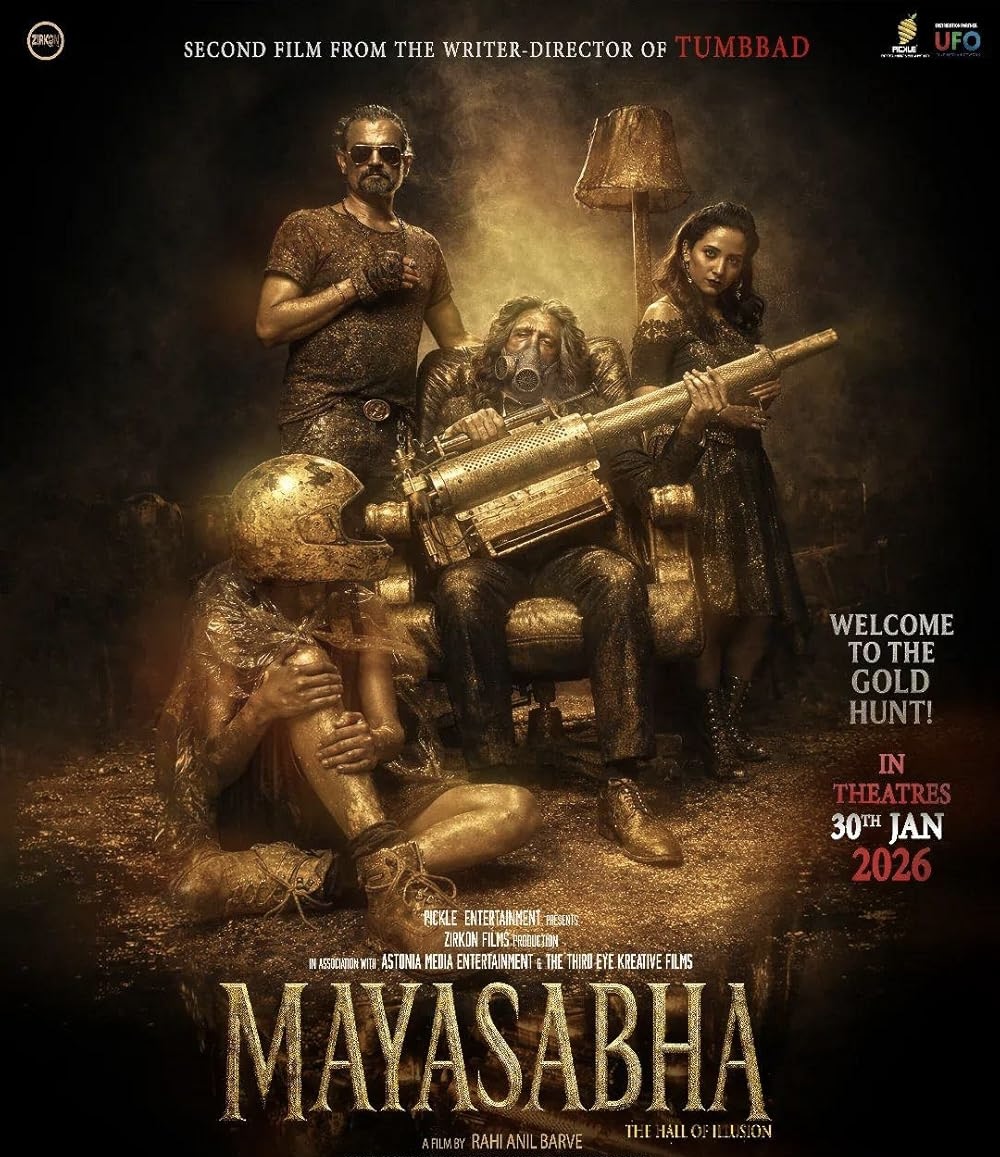
 Mayasabha, the frustrating but fascinating filmic fable from the creator of the timeless Tumbbad is not an easy film to define or categorize. It is dense and foggy, unwilling to provide us with the comfort normally provided by a movie-theatre experience.
Ironically, this widely abnormal movie experience is set in a movie theatre, a dilapidated relic of a reel run redolent of a past glory where Guru Dutt would have shot his deathless ditty ‘Waqt ne kiya kya haseen situm’. If only.
The stench of decay and death is omnipresent in Mayasabha. Art director Surendra Prajapati, production designer Preetam Rai, and co-cinematographers Kuldeep Mamania and Nuthan Nagaraj ensure that every frame flickers with a life-defying flame.
The real hero of this dark desperate and damned saga is the rickety movie theatre, groaning, and silently screaming with the burden of the past. The characters, played with a vicious vinegary vitality, are intruders in this abandoned theatre of frozen light sound and action.
Javed Jaffrey lords over this ruined relic of a gone glory. Raging like a Shakespearean hero he is the downtown version of Hamlet and Othello, with a bit of Amitabh Bachchan from Rituparno Ghosh’s Last Lear thrown in for dramatic effect.
Javed’s go-for-gold performance underlines the narrative’s nebulous profile. This is a chamber piece with four characters making the beast—and I do mean, beast—of an entire night of creepy carousal where a commode plays a crucial part.
There is a lot of playful banter in the father-son relationship between a once-successful film Parmeshwar Khanna (Jaffrey) and his son Vasu played by Mohammad Samad, so unforgettable as a child of an avaricious father in Tumbbad, now grownup and still part of a troubled father-son relationship.
As in any solidly constructed chamber piece the father-son axis moves stealthily to accommodate other characters, incompatible siblings Ravrana (Deepa Damle) and Zeenat (Veena Jamkar, an interesting melange of Vidya Balan and Tannishtha Chatterjee); the sister, if you must know, is the manipulator, the moving force in this relationship.
An entire major chunk of the narrative plonks Parmeshwar and Zeenat in a cat and mouse-and-mouse game in the dimly lit delapidated movie theatre , that can only go one way. Their conflict is structured like a skittish slasher film with a dash of tragic grandeur that challenges the dingy atmosphere.
The background score by Sagar Desai hammers in the drama without over-punctuating it.
There is a massive revelation about Parmeshwar Khanna at midpoint made by Zeenat in a shocking mocking tone. How did she get to know Parmeshwar’s awful secret? Just like Parmeshwar fumigating his past with DDT sprays, the film’s foggy images of the past leave us a bit choked, a lot perplexed and ultimately edified.