
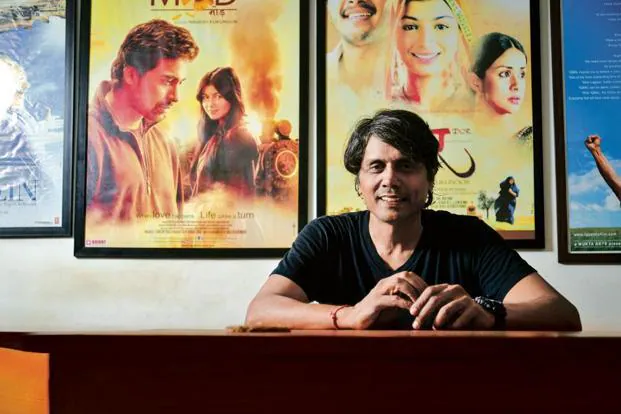
 In celebration of noted filmmaker Nagesh Kukunoor’s 59th birthday, Subhash K Jha shares his selections for the Director’s five finest films.
1. City Of Dreams Part 1 and 2 (2019, 2021): 
Produced by the ever-enterprising Applause Entertainment, this is the best political drama yet on the Indian OTT platform. What starts off seeming to be a take-off on Mani Ratnam’s political drama Chekka Chivantha Vaanam turns into an engrossing, crackling cat-and-mouse drama about a political empire in Maharashtra where siblings squabble for power after the patriarch (Atul Kulkarni) is gunned down. Straightaway, City Of Dreams encircles a cluster of power-hungry characters whose motives are never cogent, let alone comprehensible. There is always a sense of more going on here than meets the eye. Writers-directors Nagesh Kukunoor, Rohit C. Banawlikar peel off layers after layers of subterfuge to reveal a system of governance that thrives on corruption and deception. Deftly inter-woven, the plot moves in mysterious ways, embracing characters who are at once cunning and naive. The aforementioned wounded politician’s daughter, Poornima (a very lovely and emotionally empowered Priya Bapat), fights it out with her out-of-control, debauched brother, Ashish (Siddharth Chandekar). The two actors play off against one another with controlled acerbity, bringing out Shakespearean levels of power-greed as the plot unfolds in a gripping game of one-upmanship. Priya Bapat is specially effective, negotiating the power spaces that her father has vacated with guarded velocity. In one sequence, Poornima Gaekwad, accompanied by the family advisor (Jiten Pandya), meets a business benefactor friend of her father who informs her in very crude words that he is ready to be ravaged in the missionary position but won’t be sodomized. The characters shock themselves with their sudden swerve into sleaze, none more than Sandeep Kulkarni playing the political family’s money launderer. Playing a placid family man with crippling financial liabilities (money launderer with no money: get the irony), he cultivates a secret life where he watches ‘Sunny’ (as in Leone) in “Badan Part 4” and befriends a mysterious seductress. Kulkarni brings out the frightening stillness that defines his character’s existence. Not one to go down without a fight is Ajaz Khan’s burnt-out encounter cop act. He is a once-powerful man now forced to look at his pathetic personal and professional life straight in the eye. The part is memorably written. And Ajaz Khan makes the best of it, though he could have mumbled his lines more coherently. The problem with being Marlon Brando is we don’t know what he is saying. The series has some striking threads of plotting, fluttering across the episodes with inviting assuredness. My favourite is the loan agent Gautam (wonderfully played by Vishwas Kini) and his unlikely telephonic friendship with the brutalized sex worker who calls herself Katrina (Amrita Bagchi). There is potential in this friendship for a full-fledged feature film. City Of Dreams focuses not so much on the city of Mumbai as its ambitious power-hungry characters whose yearnings spill into a bloodbath. This is a well written finely performed web series with significant recall value. The writing is bold and effective, never afraid to call out its characters’ flaws, no matter how embarrassing. At one point, when the two siblings squabble over their father’s political throne, the brother tells his sister, “I am not willing to be Manmohan Singh to your Sonia Gandhi.” Politics never seemed more interesting. And farcical. The line dividing the world of politics and crime in City Of Dreams is so thin, it is almost non-existent. The simmering cornucopia of characters are forever in the danger of slipping through the cracks. And many of them do. Poor Purushottam (so poignantly pathetic as played by Sandeep Kulkarni). As Poornima Gaekwad’s trusted lieutenant, he finds himself falling into the honeytrap. Flora Saini is curiously tragic and seductive as the moll who ensnares and destroys poor Purushottam. I loved her sequence at the end where she comes to meet Purushuttom’s simple trusting wife who asks the pretty lady if her husband had an affair with her. Without blinking, Flora denies it. Sometimes a lie is worth many times more than the truth. Even Mahatma Gandhi thought so. Not that there are any Gandhian politicians in this intricately conceived game of power and deceit. Our heroine herself is no saint. She has the blood of her own brother on her hands from Season 1. Now, in Season 2, she pays the heaviest price possible for a woman and a mother. One of this season’s great joys is to watch the amazing Priya Bapat play the estranged wife of a political activist, Mahesh Aravale (Addinath M. Kothare, well played). And before we shout ‘Aandhi’ , Kothare himself describes himself as Sanjeev Kumar in Gulzar’s film and even hums Tere bina zindagi se koi to his estranged wife.
2. Dor(2008):

How far would you go for love? That’s the question which the narrative softly raises. How far would YOU go to see this film? That’s the question every movie-enthusiast should ask loudly. Very frankly, Dor takes you by complete surprise. Of course, you expect a certain aesthetic and technical finesse in a Nagesh Kukunoor creation. But nothing he has done so far—not the underrated 3 Deewaarein and certainly not the hugely feted Iqbal—prepares us for the luminous spiritual depths and the exhilarating emotional heights of Dor. The stunningly original screenplay sweeps in a caressing arc, over the separate yet bonded lives of two women, Zeenat (Gul Panag) in the snowscapes of Himachal Pradesh and Meera (Ayesha Takia) in the parched sandstorms of Rajasthan. The picaresque pilgrimage of one woman into the life of another is charted in the resplendent rhythms of a rather zingy symphony played at an octave that’s at once subdued and persuasive. Dor could any time lapse into being one of those tedious works on women’s emancipation. Kukunoor controls the emotional tide with hands that know when to exercise restrain and when to let go. Dor flies high and effortlessly in an azure sky, creating elating dips and curves in the skyline without ever letting go of the thematic thrusts that take the director as far into the realm of realism as cinematically possible, without losing out on that wonderful quality of cinematic splendour that separates poetry from sermons. Join Zeenat, then, on her bizarre, impossible quest to find an achingly young, newly widowed woman whom Zeenat has never seen, met, or even heard of until her husband’s sudden tryst with crisis. The way Kukunoor weaves the two unconnected lives in contrasting hinterlands is not short of magical. The eye for detail (take a bow, Sudeep Chatterjee, Munish Sappal , Sanjeev Dutta, and Salim-Suleiman, for conferring a subtle but skilled splendour through your cinematography, art direction, editing, and music) is so keen, you tend to stare not at the screen, but at feelings and emotions that aren’t visible. From the initial scenes of tender bonding between between the two women and their respective spouses , to the indelible sisterhood between the two bereaved women that constitutes the end-notes of this sublime celluloid symphony….Kukunoor’s world of wistful peregrinations is as fragile as it’s powerful. It’s the Takia-Panag sisterhood that sustains the narrative. Both the actresses are huge revelations, Takia winning more sympathy votes for the sheer poignancy of her character’s predicament. Scenes such as the one where she falls unconscious while hearing the news of her husband’s death over the only cellphone in the village, or the one where she furtively dances to ‘You’re my sonia’, stay etched beyond the frames.
3. Dhanak (2016):

This is a very rare product of a breed of cinema where simplicity and intelligence come together in an unlikely marriage of excellence. The main characters are a little blind boy who is a brat and a whiner and a major drama king , and his elder sister wiser beyond her years, endlessly exasperated by her kid-brother’s antics but committed to being his support and anchor as they sets off to meet, hold your breath, Shah Rukh Khan, who is committed to restoring his eyesight. The journey is interspersed with an array of interesting encounters with characters who appear so much part of the landscape you wonder if Kukunoor decided to include them in his young travellers’ journey just because they (the incidental characters) were around. Do the siblings, on a cross-country trek through rural Rajasthan, meet Mr Khan? Let’s just say Dhanak is a far better and more worthy tribute to the stardom and aura of Shah Rukh Khan than the recent Fan which messed it up by getting the superstar-fan relationship wrong in the second-half.Dhanak doesn’t strike one false note. The two young protagonists played by Krish Chanria and Hetal Gada are such natural-born actors you wonder where Kukunoor found them. The two children bring unconditional joy to the script. And they speak a language that is real vital and believable. The conversations between the 8-going-on-9-year-old Chotu and his 11-year-old sister ring so true, it’s like watching them without the camera. As the two children set off on a cross-country journey to meet the superstar Nagesh’s elegant, simple, and lucid screenplay weaves into the plot the kind of close encounters of the thundering kind that exposes the two kids into an incredibly expansive world of kindness and generosity. Nagesh shoots Rajasthan’s desertscape with a reined-in luminosity, neither over-punctuating the topography for emotional impact nor underplaying it for the sake of counter-touristic brevity. Not since the cinema of J P Dutta has Rajasthan been shot with such skilful serenity. Chirantan Das is a poet masquerading as a cinematographer.The film’s other commendable component is the eventful music score by Tapas Relia. The songs and music urge little sightless Chotu’s adventures into areas of sunshine, even when the clouds loom large. Barring one near-catastrophic encounter with kidnappers, Chotu and his protective sister never come face-to-face with peril. I wouldn’t say that’s a blind spot in the narrative. Good knows, in a world that addresses itself to a drugged-out diabolism, we need all the sunshine and positivity we can get. Without overdoing it, Dhanak offers ample doses of both. No, you really can’t pluck holes in Nagesh Kukunoor’s enchanting excursion into the heart of innocence and salvation. This is a heartwarming ode to the dying spirit of the human and selfless compassion . Moving, funny, and memorable, the two child actors are miraculous. Ditto the film.
4. 3 Deewarein (2003):
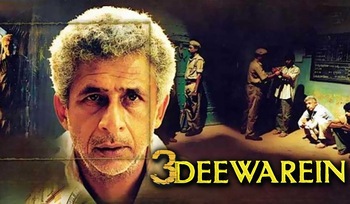
Nagesh Kukunoor’s much talked-about prison drama is everything that you expect it tobe—hardhitting, gritty, absorbing, real, and raw—and then some more. The finale is so imposingly conceived you want to salute the director for simply taking the initiative of stretching the outer limits of mass-oriented entertainment. For make no mistake, 3 Deewarein isn’t a small arthouse film. Its vision of a prison is as grand as The Shawshank Redemption, though contrary to simplistic readings of Kukunoor’s intriguing jigsaw on life, death, and love, it doesn’t imitate a single moment from that famous Hollywood prison drama. Kukunoor touches upon the theme of capital punishment without really making a central issue of the matter. His three heroes, Ishaan (Naseeruddin Shah), Jaggu (JackieShroff), and Nagya (Nagesh Kukunoor), are on death row. More than their impending end, it’s their life that interests Kukunoor. Having got satirical laughter out of himself and us, in Hyderabad Blues and Bollywood Calling, Kukunoor now spreads his discernible strong vision of human caprice and destiny’s damning jokes across the theme of great power. 3 Deewarein is a prison story that had to be told. The characters, big or small, are so palpable in their pain, we feel their presence long after the film finishes. The greatest gift that Kukunoor gives us is his perception of a full life. Desperate, anxious, and desolate, his protagonists gather a glint of hope in their demeanour that spreads like a sheen of sunshine across this film’s seminal skyline. Without dwelling on the metaphorical aspect of the jail tale, Kukunoor creates some stirring moments of pure cinema where poetry and parody flow in a free-flowing embrace of life and death. Each of the three prisoner-heroes has his own murderous story to tell. By the time they are ready to spill the beans, we’re completely hooked to their lives. The minute, Juhi Chawla, playing a small-time filmmaker Chandrika, steps behind the prison walls, we know what’s in store, and yet by a perverse passion for predictability, we want more . Much more of that splendid mixture of life and death that pours out of the narrative in leisured tones. Juhi Chawla’s character holds the key to the drama. As the Florence Nightingale who isn’t as frail and powerless as she (or we) initially believe her to be, Juhi makes you wonder where she’s been holding in that immense sensitivity and depth. In some sequences specially where her brutish screen husband (Shrivallab Vyas) abuses her, Juhi is a storehouse of reigned-in versatility. It would be criminal for Hindi cinema to lose this delicately potent actress to motherhood. Kukunoor extracts first-rate performances from the whole cast. The three protagonists (Kukunoor included) get under the skin of their characters. Of course, as always, Naseeruddin Shah has a head start. His role is markedly more special than the others. Shah plays the smooth-talking jailbird as though he had lived in a prison cell all his life. That , in so many cases, is true of every character. As Juhi interacts with her incarcerated subjects, she becomes conscious of her own life’s impregnable walls and how seriously she needs to break them. In her realization resides the film’s main strength. The interactive drama among Juhi and her three prison friends is absorbing and cinematically astute. Just when we begin to applaud Kukunoor for his sensitive portrayal of shipwrecked lives, he drops a huge boulder of cinematic surprises on us. The end-game, where the narrative’s scattered sensations of crime and banishment come together in a neat bundle, may seem over-clever, almost self-congratulatory. But Kukunoor knows what he’s doing. Having brought his characters so close to our hearts, he doesn’t want to break them—the characters or our hearts. The flamboyantly victorious finale is that corkscrew twist in this dazzlingly tormented tale to give a concluding vitality to lives that are frail but never pales. The colours of the prison are just that shade deeper than normal. Ajay Vincent’s cinematography is rich but never overdone. The actors have seldom looked more vivid in their pain. As you watch them enshrined in their outer and inner prisons, you realize cinema needn’t be epic in canvas to scale the wall of greatness. 3 Deewarein is a remarkable piece offictionalized life . It isn’t squeamish about life’s ugly truths (the scene where one of the gentler prisoners is raped by the HIV infected prison bully makes us flinch). But, like Jaggu in the film, the director looks for poetry in the squalor of existence. And he finds it.
5. Aashayein(2010):
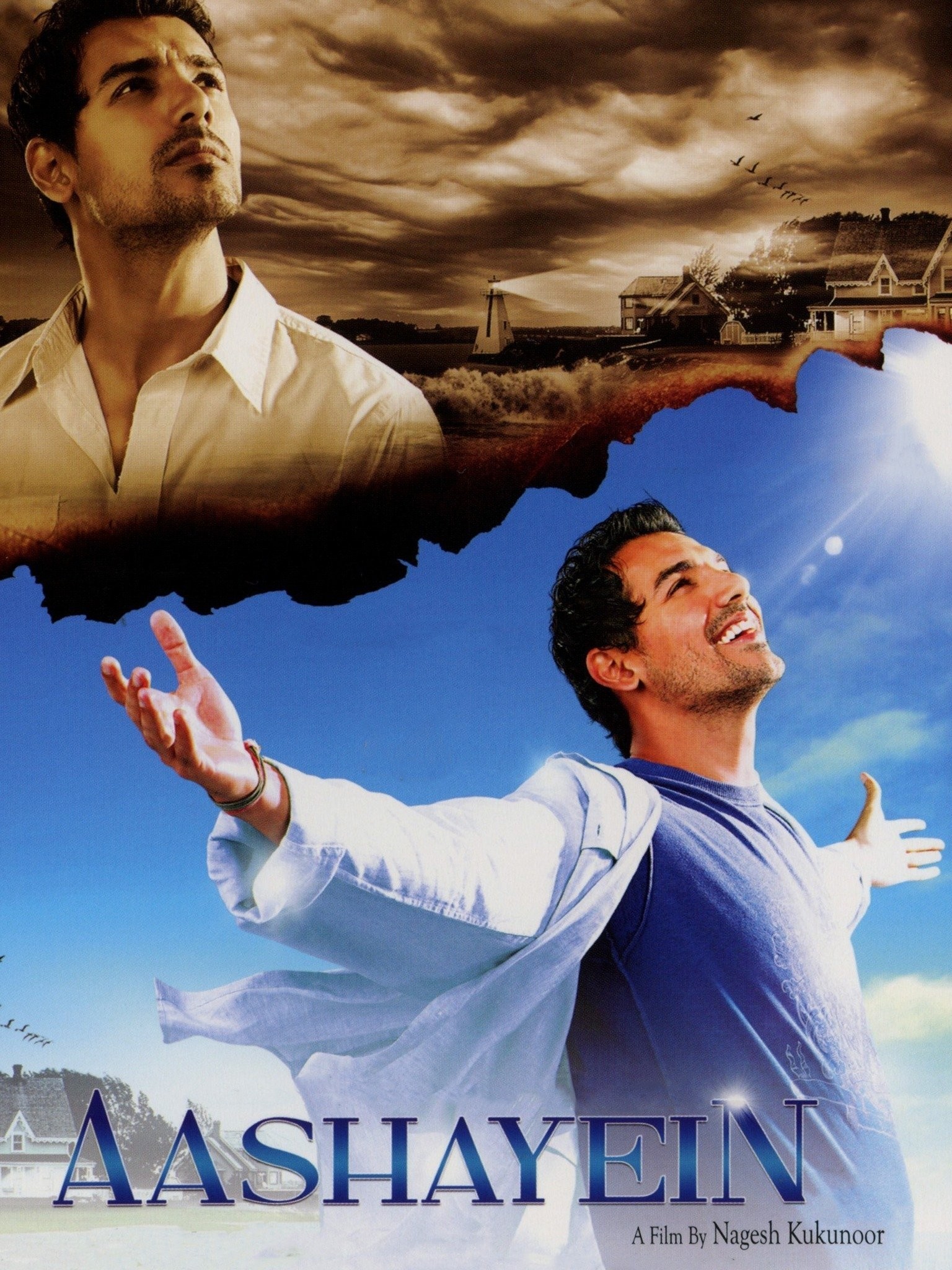
This film is structured as a journey from a bright delusory light into a place where the radiance comes from a consciousness of why mortality is not to be feared. In John Abraham’s eyes are mapped the entire history of the human heart, its follies and foibles as it struggles to make coherent the indecipherable logistics that define our journey across that bridge which everyone crosses from this world to the next. As that very fine actress Prateeksha Lonkar (a Kukunoor favourite) says, “The only difference between the healthy and the ill is that the former don’t know when they are dying and the latter do.” Between that state of blissful oblivion where we all think life is forever (and a day) and that one moment when our delusions come crashing down, there resides some very fine cinema. Hrishikesh Mukherjee’s Anand, where Rajesh Khanna smiled his way through that wobbly bridge taking us to the next world, is an interesting reference point in Aashayein. I also thought of the actress Supriya Choudhary in Ritwick Ghatak’s Meghe Dhaka Tara, shouting into the dispassionate mists of the mountains, “I want to live.” The echoes reverberate all the way to Kukunoor’s heart, a warming, funny, and elegiac exposition on the truth that lies on the other side of that illusory mountain we call life. Kukunoor pays homage to life per se, and life as we know in the movies about death. Even in the most poignant places in the art, Kukunoor ferrets out some humour. When John’s lovely girlfriend (Sonal Sehgal) hunts him down in his exilic place of the dying, John quips, “So, you are not going to behave like one of those heroines in films who dumps the dying hero?” The fantasy element creeps into the hospice (yes, that’s the spotless space that the story inhabits unostentatiously) with the least amount of fuss. There’s a little boy (the bright and expressive Ashwin Chaitale) who weaves mystical tales borrowed from the comic books for the desperate and the dying. Here, Kukunoor brings in an element of rakish adventure borrowed from the edgy hijinks of Indiana Jones. Who says money can’t buy love? John uses bundles of cash to bring a smile into these doomed lives. When he doubles up with pain in womb-like postures of helplessness, we feel his pain. John, in Harrison Ford’s hat and whip, cuts a starry figure. He has never been more fetchingly photographed. John’s smile reaches his eyes, makes its way to his heart, and then to ours. This film opens new doors in John’s histrionic hospice . It’s a performance that heals and nurtures. John’s finest moments are reserved for a hot-tempered, sharp-tongued 17-year-old girl in a wheelchair, played with intuitive warmth by Anaitha Nayar. He guides the relationship between these two unlikely comrades of unwellness with brilliant restrain and candour. She wants him to make love. He does with his eyes, using his unshed tears as lyrical lubricant. Here is a performance that defines the character through immense measures of unspoken anguish. Rajesh Khanna in Anand? Nope. John pitches his performance at a more wry and cynical world where true feelings are often smothered in worldly sprints across a wounded civilization. This is unarguably Kukunoor’s most sensitive and moving work since Iqbal. We often find little sobs pounding at the base of our stomachs. Not all the characters or situations are fully formed and fructified. But even the partly-realized truths in Aashayein convey more common sense and uncommon affection for life than the “entertainers” of today’s cinema, where laughter is generated through cracks in places very far removed from the heart.