

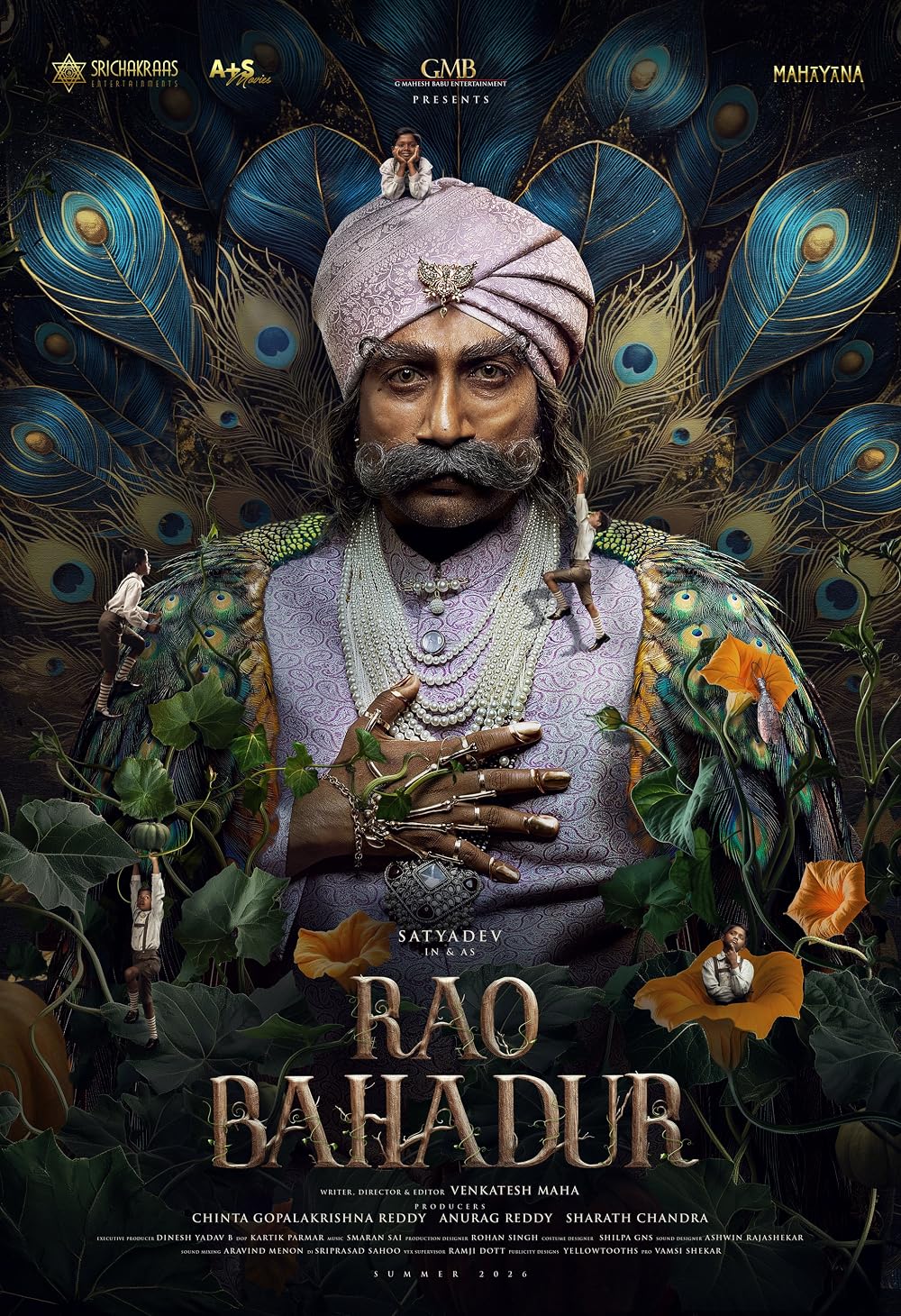
 Love it, hate it. But you can’t be indifferent to what writer-director Venkatesh Maha has done in the riotously wonky Rao Bahadur (Telugu), a film so twisted in its head that you will carry it to your bed and then wake up wondering what you saw the night before.
At the centre of the chaos is the self-anointed aristocrat Bhuvanam Ramappa Rao Bahadur (Satyadev in a make-or-break role) living in a state of heightened delusion in his crumbling mansion with his obdurate househelp Achchamma (Bala Parasar) and a wife (Deepa Thomas) who hasn’t spoken to him nor come out of her room for years.
It is a decadent world, the mansion a portrait of exacerbated self-delusional feudalism, fed and fuelled by the writer-director Venkatesh Maha’s penchant for magic realism when you least expect it.
What if Satyajit Ray’s Jalasagar met Isabel Allende’s The House of the Spirits? What if the sun never set on the freakish empire? What if cinema was not about making sense? What if it was about climbing the endless stairs of absurdity without fear of tripping and falling?
Above all, Rao Bahadur is about daring to do what cinema has never done before. Venkatesh Maha falls back; no source reference. He takes off on his own trip.
Trippy and treacherous, the film takes us from one cheeky, madcap adventure to another without fear of the fall. The narrative does falter at times, especially when it breaks into hereditary songs and dances with all of the protagonist’s ancestors gathered together in a capricious, quirky clasp.
As Bhuvanam Ramappa Rao Bahadur’s mind unravels, so does the film’s narrative, gamboling as it does from blatant surrealism to subtle bathos. Never unwinding from its ever-ricocheting antics, the screenplay is perky, prankish, and quite simply outrageous.
Top-heavy in its ambitions, the storytelling feeds and fuels the protagonist’s overwrought mind with images that stump our senses. At one point, the demented protagonist is seen conversing with ‘Sanjay Gandhi’ (on sterilization!), who is not there, of course. Only Rao Bahadur can see him. That is the magic of cinema at its absurdist and sublimest.
There is ample room here for the sublime and the ridiculous. The nubile narrative subsumes both without tripping over the invisible lines that divide creativity from self-indulgence. A large part of the success of this eccentric excursion into ancestry and lineage goes to the lead actor Satyadev who is up to the task of flaunting his character’s self-mocking mask of decadent glory.
The supporting cast is rather pale. Maybe they just didn’t get it. Or even if they did, they didn’t know what to do with the plot’s prickly mix of mirth and pathos.
The best parts of the film are about the rise and fall of a love so elevated that its passing becomes a symbol of life’s transience and, by extension, art’s durability.