
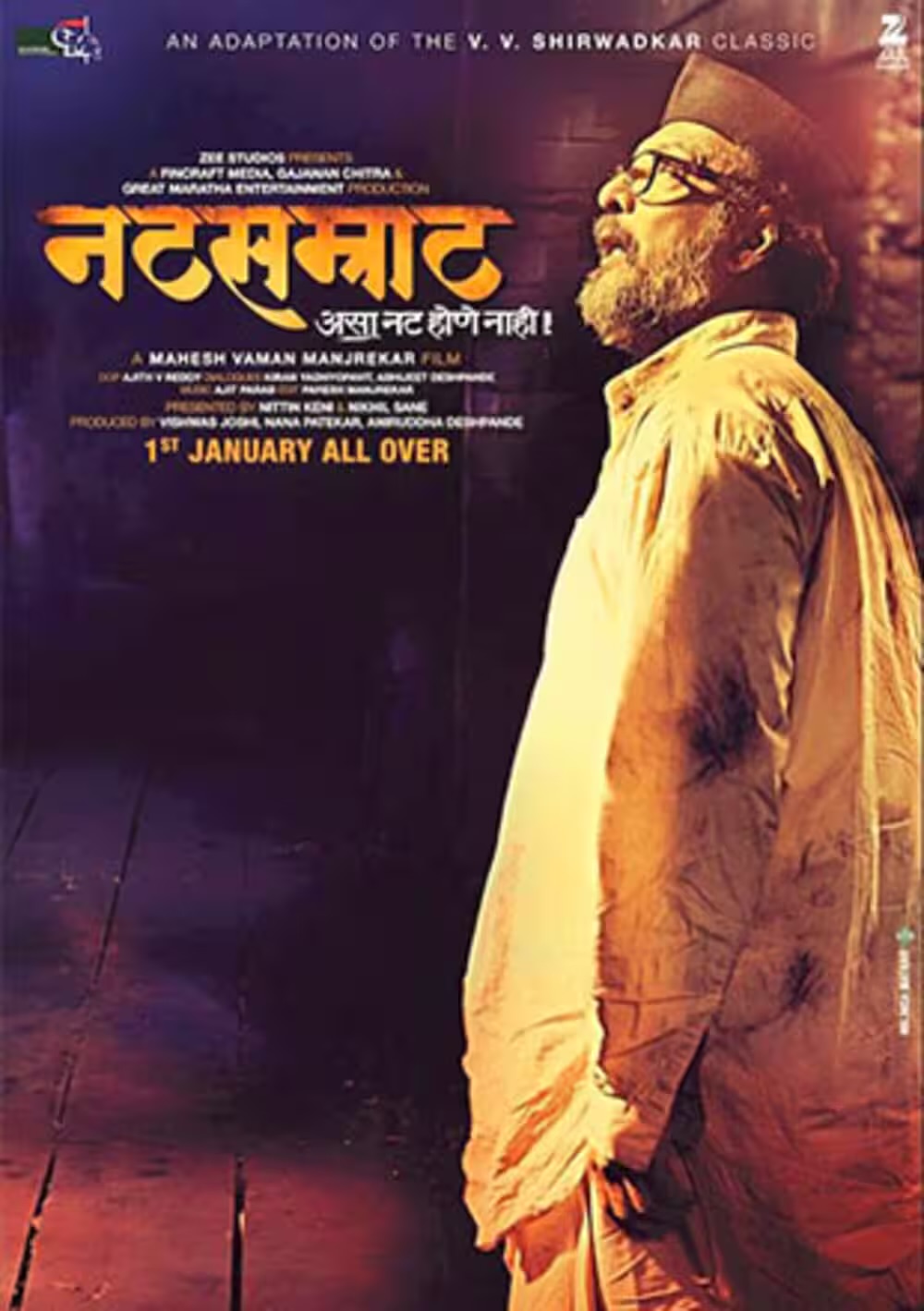
 Subhash K Jha shines the spotlight on Nana Patekar’s finest onscreen performance as he revisits Natsamrat in this special feature.
The first week of the new year in 2016 gifted movie buffs plenty of reason to rejoice. Mahesh Manjrekar’s Natsamrat is the kind of emotional cinema that moistens your eyes and cleanses your soul. Even the most hardened and cynical moviegoer would find it hard not to be moved by the plight of Ganpat Belwiker, theatre actor par excellence who foolishly believes his children will look after him after retirement.
Silly sentimental fool!
“Be careful of what you give away,” warns Ganpat’s sensible wife (Medha Manjrekar, suitably subdued, serene and subtle) a little too late. By then, the floodgates of ingratitude have already opened up in Ganpat’s life. With soul-shattering resonance, we hear his heart being broken time after time.
In the tradition of L V Prasad’s Bidaai, Ravi Tandon’s Zindagi, Mohan Kumar’s Avatar and Ravi Chopra’s Bagbaan, Mahesh Manjrekar’s Natsamrat lifts the torn curtain of parental pride and filial betrayal, revealing the fissures under the veneer of traditional family values that we carry from generation to generation in the mistaken belief that blood ties will, eventually, conquer more elementary emotions such as greed and self-interest.
The scenes of domestic disharmony are done in disquieting elemental tones, as though the director wants us to feel the full weight of Ganpat’s sense of injured pride. Natsamrat is a very old-fashioned melodramatic morality tale, and that’s the highest compliment I can pay this extraordinarily rich emotional drama. In an era of fast-food visual gratification, Natsamrat is like an aromatic home-made thaali, the vegetables made with the purest home-ground spices. The film is steeply dramatic—as it ought to be, since it owes its thematic allegiance to the world of theatre, Marathi theatre, to be more exact.
Indeed, one of the residual joys of watching this expansive tear-jerker is its affectionate and enthusiastic evocation of theatre greats from V V Shirwadkar to Shakespeare and, yes, even Tennessee Williams’ A Streetcar Named Desire. Dexterously, the director brings in idea of Old Theatre versus New Theatre, of changing more in theatre and in life, that somehow get inextricably mixed in Ganpat’s sensibilities, a conflict of perceptional interests that triggers off a chain of tragic incidents that him isolate from his social obligation to the point of self-annihilation.

Creative nihilism is a theme that thunders passionately across the film. To hear Nana Patekar recite impassioned monologues of theatre-greats is a treat for all lovers of stage performances, but also a distracting device that distances us from the world that Ganpat inhabits, as much as it distances him from his immediate surroundings. And yet there is a lot to be said about Patekar’s propensity to own his character’s raging recitations. The brilliant actor, better here than in any of his Bollywood films of the time (could we please obliterate Welcome Back from his repertoire?), simply possesses his lines in the way Mohammad Rafi would possess the lyrics that he sang.
At times, the pounding, shattering truth of Patekar/Ganpat’s words hits us where it hurts most. After being betrayed and humiliated by his favourite child when she comes to ask his forgiveness, Patekar observer how helpless parents become when they are dependent on their children.
“You must have thought we are like dogs tied to your backyard. Where can we go?” Patekar tells his penitent daughter.
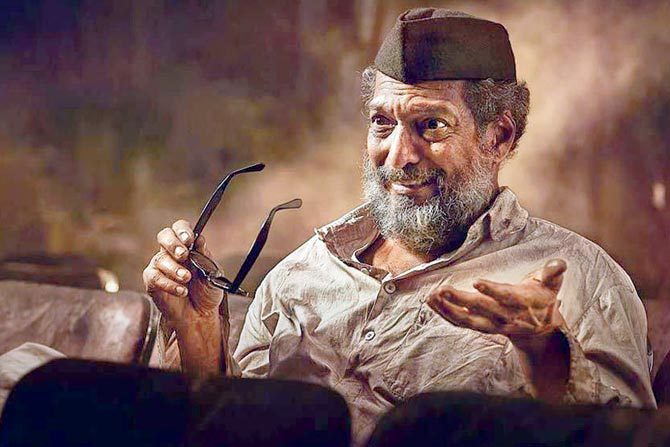
At a time when there’s a disturbing tendency in our society to abandon aging parents, Natsamrat throws the gauntlet of filial ingratitude into audiences’ faces, leaving us with a sense of guilt that has no immediate bearing. The feeling of abandonment and dereliction that Ganpat experiences are demons that would come to visit all of us one day. The universal theme of Natsamrat makes it one of the most important films in recent times.
There are many episodes from this infuriatingly moving drama that had me in tears. Wisely Manjrekar anchors Ganpat’s humane side to his relationship with his wife Kaveri and his best friend Rambhau (Vikram Gokhale). In the film’s finest moments, we see Ganpat’s life through the eyes of these two people closest to him.
While the film is an unabashed showcase of Nana Patekar’s powers as an actor, Vikram Gokhale as Rambhau is equally compelling. The sequence on his deathbed, when Gokhale recites lines from the Mahabharat, makes our hairs stand on end. This is an actor at the crest of his performing ability.
As for Patekar, at 65 he proved great actors don’t fade away. They simply burn brighter with the growing awareness of mortality. This performance of a man raging against human injustices and God’s quirky decree will rank among the most towering performances of Indian cinema.
Thank you, Nana, for reminding us of your greatness. Thank you, writers Kiran Yadnopavit, Abhijeet Deshpande for bringing alive a 45-year old play to remind us that great writing is ever renewable. Thank you, cinematographer Ajith V Reddy, for mapping the characters’ hearts with as much vividness as their faces(though here I must confess the supporting cast is just not on a par with the looming lead actors).
Thank you, Mahesh Manjrekar, for restoring our faith in a cinema that speaks a straight emotional language and doesn’t borrow its sensitivities from European cinema. It is hard to associate the director of this film with the same man who once upon a time made a series of good, bad, and ugly underworld films. With Kaaksparsh in 2012 and now Natsamrat in 2016, Manjrekar seemed to have found his métier.
Natsamrat as a film that tugs persuasively at our heartstrings. It will remain the most lingering, luminous legacy of Nana Patekar’s raw, visceral energy on screen.