
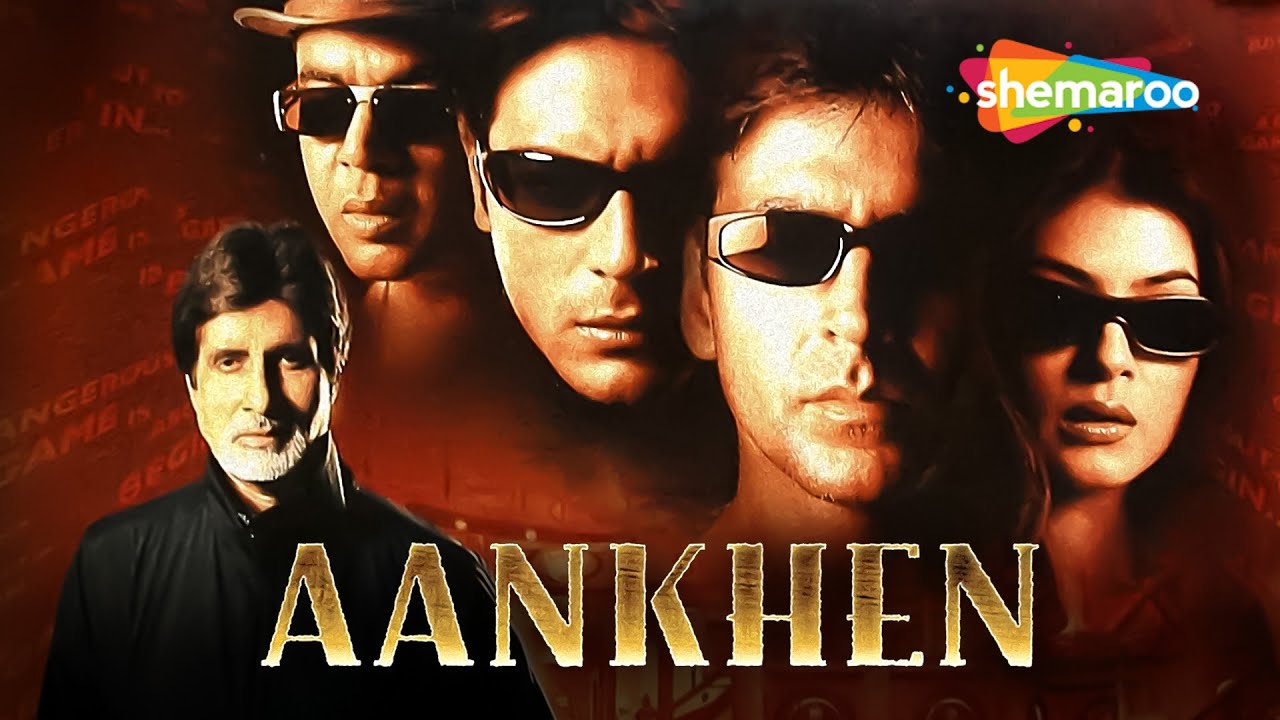
 Subhash K Jha takes a look back at Vioul Shah’s crime drama Aankhen that released in 2002.
“Truth is stranger than fiction,” is a favourite throwaway line of all characters in this intriguing hide and freak game.
The truth behind the fiction in Aankhen, which clocks 24 years on April 5, sure is strange, no matter how we look at it. Adapted from the director’s Gujarati stage play, Aankhen is an ensemble piece that tries to turns the inherent staginess of the material into the film’s biggest USP.
Though the characters confab, conspire and conversate incessantly, as is the wont in plays, they also convey a lived-in density through their immense interactive inpulses. The rest is taken care of by the swift and sleek production values, which communicate the basic virtues of star power without making the ultra-charismatic stars a puppet to the box office.
Aankhen is about an obsessively disciplined bank manager Vijay Rajput (Amitabh Bachchan) who gets fired from his job for roughing up a corrupt staffer. Within a split second Rajput’s carefully cultivated world of passionate devotion and high-powered principles come crashing down in an inverted-pyramid of humiliation and acrimony. He begins to plot the downfall of the very workplace that he worshipped.
Rajput’s transformation from worship to war–ship is represented by his devious plan to rob the bank to which he gave all his life. He recruits Neha (Sushmita Sen), a teacher at a blind school, to train three handpicked blind men, Vishwas (Akshay Kumar), Arjun (Arjun Rampal), and Ilyas (Paresh Rawail), to undertake the most audacious bank robbery man has ever seen. Or not seen, as it happens to be.
It isn’t often that a film, let alone a mainstream Hindi film, looks at the physically challenged with compassion, understanding and benign humour. Aatish Kapadia’s self-adapted screenplay from his stage play works out the three blind characters’ mutual empathy in so much detail that we gradually begin to inhabit their dark but strangely illuminated world.
First-time director Vipul Shah is lucky to get a cast which simply sweeps into the plot’s incredible arc of redemptive retribution. Amitabh Bachchan, in the first fully-fledged negative role of his career since Parwana , performs the most discomforting villainy (for example, tickling the Paresh Rawail character to death) with a startling sincerity. His face contorts subtly into a grimace and reverts to a pokerfaced neutrality in the blink of an eye. During the bank robbery , Bachchan’s split-second physical manoeuvres epitomize the spirit of immediacy and urgency that somehow eludes a major of part of this stagey thriller.
Paresh Rawail as the comic member of robbery gang effortlessly yolks laughter with harrowing recollections of his childhood when he was kidnapped and forcibly blinded to beg on the streets of Mumbai. Rawail’s character keeps the improbable proceedings grounded to reality. Here’s one actor who never lets a script down.
The third scene-stealer in the film is Akshay Kumar. As the shrewd and clairvoyant Vishwas who senses the presence of the mastermind in their midst Akshay brings a certain aromatic flavour to the blind man’s character. In a couple of dramatic sequences where he recalls his past and the sequences where he moves towards the Bachchan’s non-visible but ubiquitous figure in the room where the’re being trained for the heist, Akshay communicates a very appealing street wisdom. But his shots of affluent luxury in flashbacks make no sense. If he lived life king-size, why did he agree to part of a robbery for a mere 50 lakh rupees?
Sushmita Sen, as Rajput’s reluctant liaison officer, suffers in an underwritten role. As usual, she creates space for herself and plays her part with complete conviction. This is the first time that Sushmita has played the part of a victim and a leading lady who has no song to sing during the course of the narrative!
Apart from the blind trio’s friendship song the music , including Akshay’s totally irrelevant seduction duet with Bipasha Basu, come in the way of the film’s teacher-and-the-‘taut’ design. As for Kashmira Shah’s dance in the den, it carries the narrative’s course to the coarse.
The theme of the film—the planning and execution of a bank robbery—is so much a part of Hollywood cinema that the Indianizations in the form of romantic/raunchy songs come as intrusive interjections. And yet first-time director Vipul Shah takes enough risks with the mainstream genre and with the images of his high-profile cast, to make us think kindly about his compelling intentions.
The slickness that Shah tries to bring into the heist is saved from going to waste by a host of devices. Veteran cameraman Ashok Mehta shoots the characters and the bank-sets in granite and pastel colours that underscore the credibility–quotient of the outrageous crime plan.
But the freentic sweaty end-game with the Big B pulling out all stops to play a snarling sneering epitome of evil finally collapses in a incredulous heap. At the end, we are left with a film that’s unlike any we’ve seen in Hindi cinema. But it isn’t a fully-formed work of art. Vipul Shah gets the basics right. He removes a lot of the staginess from the original material, but not enough.
Finally, it’s the stars Amitabh Bachchan, Akshay Kumar, and Paresh Rawal who keep you hooked till the end of the blind man’s buff.