
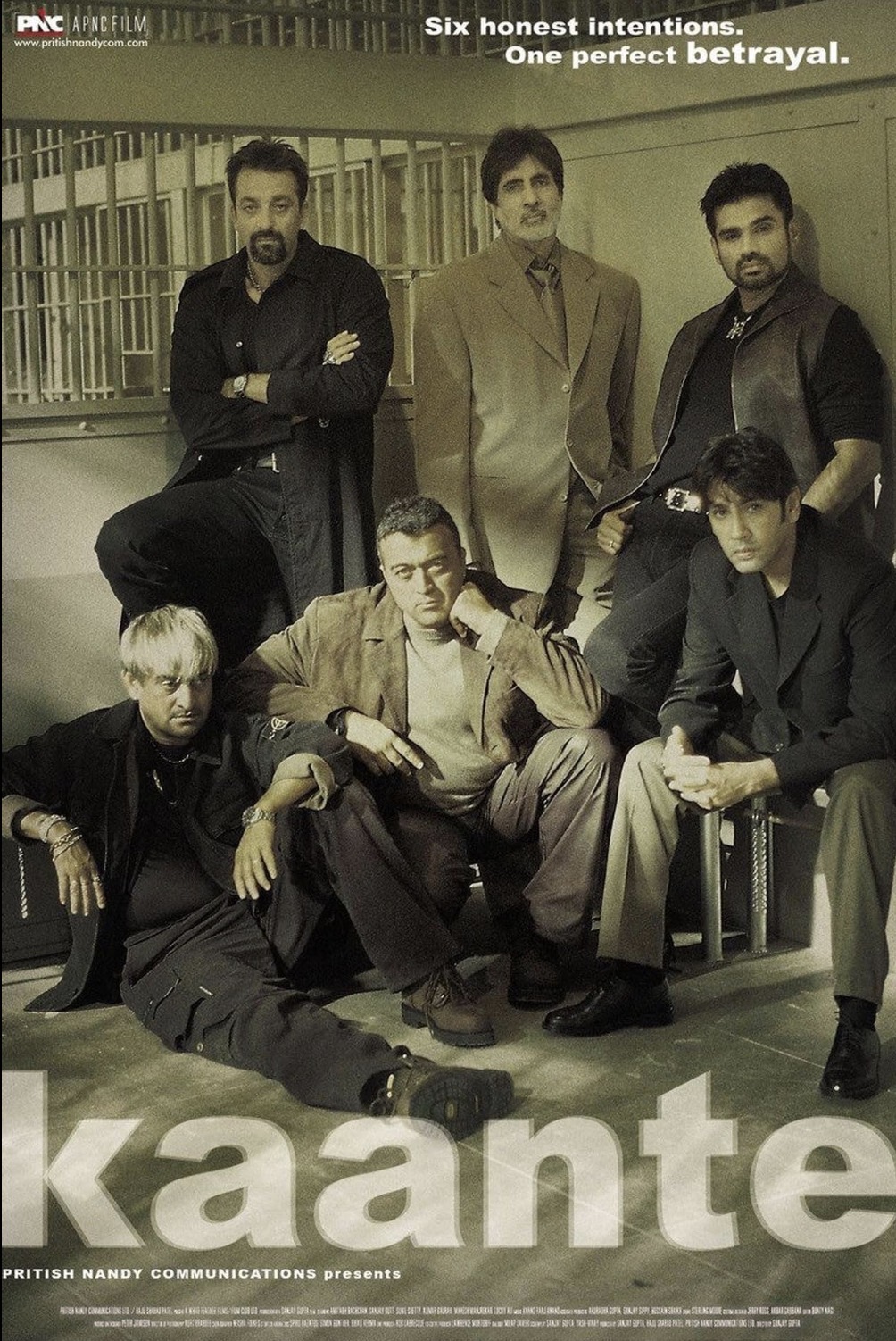
 Subhash K Jha looks back at Sanjay Gupta’s 2002 drama Kaante which starred Suneil Shetty, Samjay Dutt and Amitabh Bachchan.
There’re no superfluous moments in Sanjay Gupta’s Kaante, only superfluous human lives. Desperate people on the brink, ready to lose their soul for a few million dollars more.
But is money really the main issue in this interesting but borrowed study of criminality? It certainly is for the producers, who have staked a sizeable fortune in filming Mumbai’s first film shot in LA with a Hollywood crew. And money certainly SEEMS the main issue for the plot’s six desperados who decide to rob a bank in Los Angeles , as much as an imperialistic vendetta as for the thrill of caressing the currency.
The film certainly socks it hard in the jaw to the Americans and to mainstream Hindi cinema , in equal measures. We’ve six LA-based Indian anti-heroes, all characters rather than stereotypes, who rob American money right at the hubbub of George Bush’s territory and , unlike other NRI heroes, don’t spend their time singing songs about homesick patriotism.
Survival with a bit of dignity thrown in, is what unites Ajju (Sanjay Dutt), Mark (Suneil Shetty), Andy (Kumar Gaurav), Baali (Manjrekar), Mack (Lucky Ali) and Major (Amitabh Bachchan). Director Sanjay Gupta weaves their tortured lives together in a slinky labyrinth of male camaraderie and swivelling rivalry.
Gupta cuts his film with a surgeon’s scalpel. There’s a precise energy flowing into the narrative. Even during the dreaded songs we feel a kinetic power gripping the frames. For once the songs (by Anand Raj Anand) and the brilliant background music (by Viju Sha) go a long way in providing an intense immediacy to the plot.
The prologue where the six ‘heroes’ meet in a jail cell in LA is fraught with frisson and fury. That combination of flippant sociopathy and tragic inevitability never abandons the film. The buildup towards the grand robbery is staged with such crisp comprehension that we wonder how the director has been able enter the psychology of criminal behaviour with such casual strides.
The problems in the narrative begin in the second-half when Gupta appropriates scenes, location and even dialogues from Quentin Tarantino’s gangster classic Reservoir Dogs. If one has seen the original the pleasure of watching these six fully- charged and clued-in actors playing internally squabbling desperados, gets dissipated.
To the director and his stunning ensemble cast’s credit, Tarantino’s original screenplay is opened up in Kaante . The festering wounds that the criminal characters display as they haggle, argue, quarrel and finally kill each other, are chunks of well-grounded cinema. The most humorous and revealing moments in the storytelling occur in the first, original half where Gupta weaves little human-interest stories into the bank robber’s wife. Major’s dying wife (Rati Agnihotri) , Andy’s broken marriage and Mark’s over-possessive love for a bar dancer (Malaika Arora) are given just enough space in the tightly cordoned , deftly edited (by Bunty Nagi) crime caper, to flavour the fury.
Two of the most irradiant sequences of male bonding occur in the second-half. When Mark (Sunil Shetty) and Ajju (Sanjay Dutt) go to the dock to retrieve the robbed money Ajju ribs his partner about his girlfriend only to provoke Mark into a realization of love. And when Major (Bachchan) returns to Andy (Gaurav) in the car after finding his wife dead in their apartment, the strong and silent empathy that flows from one man to the other , is overpoweringly strong. We can’t take our eyes of Bachchan here.
Kaante is a film of strong and potent bodily juices: blood adrenaline and semen spill into the narrative to create the most aggressively macho Hindi film since Ramesh Sippy’s Sholay. Unlike the other vendetta epic Kaante concentrates almost entirely on the male characters, building a growing tension among them and their clustrophobic and hostile environment with a single-minded severity.
The cinematography by Kurt Brabbee creates a smouldering sepia-toned . Anurag Kashyap’s dialogues are pithy pungent and in character with the loutish sextet’s temperament. Specially funnily written are the words during a police interrogation when Sanjay Dutt is questioned by an American cop . The translator played by Ranjit Chowdhary has a tough time trying not to translate Dutt’s offensive remarks in Hindi about the American cop’s wife.
Indeed Kaante takes sweet revenge on Western imperialism and all the ignominy it has heaped on Indians from Colonial days to post-9/11 by making the sextet of overwrought protagonits NRIs torture an American cop to death.
Gupta’s capacious caper wouldn’t have worked without the brilliant performances. Each player adds a special sheen to his wonderfully written characters. While Manjrekar’s stuttering psycho is a scenestealeer, Amitabh Bachchan brings a steel-edged desperation to his character that melts into spousal affection each time he’s with his wife. Sanjay Dutt too is riveting. All this star has to do is stand in the frame for audiences to anticipate a revved- up tension. Footage-wise and in terms of dialogues the other 3 principal players are disadvantaged.
Sanjay Gupta finally comes into his own with Kaante. The fact that he’s able to exercize such immense tonal and spatial control over his characters and narrative is a measure of his skills as a mature ranconteur. Kaante is a film that breaks many myths about mainstream cinema. It’s mean-mooded, dark-hued direct and bluntly pitched. Life’s ugly welters never seemed more vigilant.