
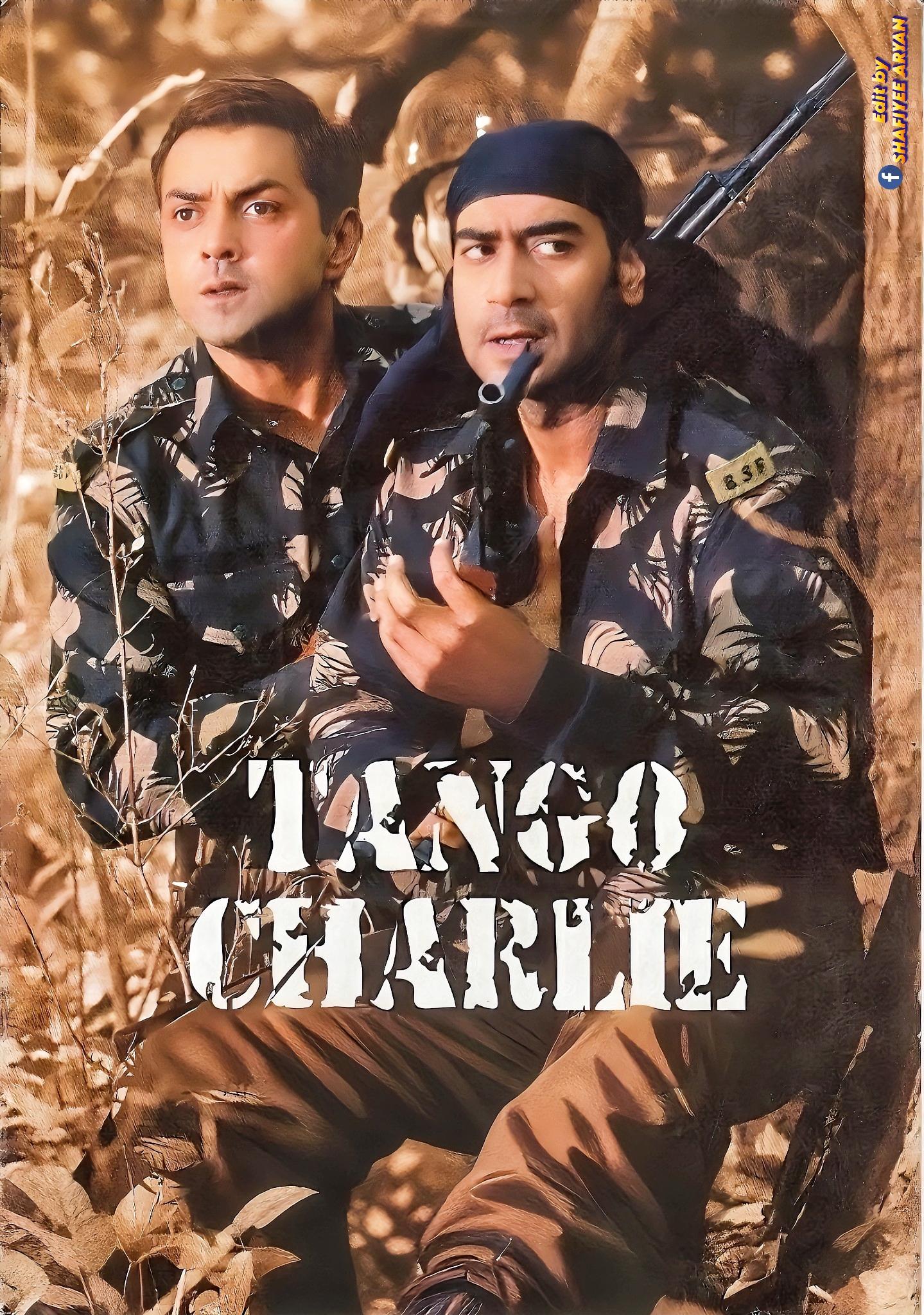
 Subhash K Jha looks back Mani Shankar’s drama, Tango Charlie, which starred Bobby Deol and Ajay Devgan in this new edition of This Day That Year.
2005 seemed to be a decisive year for Hindi cinema. Frontiers were being opened up constantly, almost by the week.
A new dimension to the war epic emerges from Mani Shankar’s fascinating study of terrorism, violence, and valour. In its efforts to take the conventions of storytelling in our cinema beyond the precincts of the predictable, and in its delineation of historic processes as a pyramid of capricious outbursts of violent protest, Tango Charlie is incredibly intense in scope.
Holding on to key pockets of terrorist activities in Indian history, Mani Shankar creates a fascinating collage of geo-political aggression whereby characters are thrown from one level of separatist violence to another until the plot is virtually shell-shocked.
Tango Charlie looks at ‘war’ as a state of the mind as seen through the mind of the State. There are no politicians in the film. But politics populates the plot abundantly. It’s indeed remarkable how the director fuses the main characters from the Border Security Force(BSF) into a spiraling demonstration of battle lines drawn between war and terrorism.
Caught between protecting the country and making spot-decisions distinguishing crime and nationalism, the two protagonists spin dizzyingly from one episodic depiction of counter-terrorism to another—the BODO insurgence in North-East India, the naxalite movement in Bengal and Andhra Pradesh, the Gujarat riots, and finally Kargil where in a tribute to David Lean’s A Bridge Too Far, Mani Shankar ekes out a stunning climactic pow-wow for his two protagonists Mohammad Ali(Devgan) and Tarun Chauhan(Deol).
We journey across a frenzied hinterland of strife and bloodshed with the two heroes —one a seasoned cynic, the other a reluctant rookie, but both joined at the hip and the lip by a narrative that moves sure-footedly through a harsh and rugged territory.
For a film that’s predominantly macho (like Shankar’s earlier film, the interestingly paced 16 December and the failed Rudraksh, Tango Charlie too precludes woman audiences) the two female leads are memorably etched, though not played with the charm and gusto that the roles deserved.
The light romantic portions with Tanishaa cast as a spunky village-based livewire who asks the naïve Tarun if he has brushed his teeth before kissing her “Hollywood style” are illustrations of tongue-in-cheek screenwriting. Nandana Sen’s extended cameo as a zamindar’s daughter in Naxalite-infested Bengal, who turns goes from bride to widow to fugitive within daze is again, proof of how expertly women can be fitted into a predominantly male domain.
For sure, Mani Shankar is better at writing his energetic, high-octane adventure than putting it on screen. Like Mani Ratnam’s Yuva, the execution of the episodic incidents is a definite departure from the orthodox format of storytelling in Hindi films. But audiences are bound to wonder why there’re so many plots-within-plots .
The director constantly courts the unconventional. Not all the scattered homages to the hiccups of history hold together. But Tango Charlie never gets dull. At work or at play the protagonists seem to exude an authoritative and credible energy.
Wisely the film unfolds in a diary format with two airforcle pilots (Sanjay Dutt and Suniel Shetty in endearing cameos) reading through the unconscious BSF jawan Bobby Deol’s jottings. Using the diary device Mani Shankar provokes us to look at the socio-political forces in different parts of the Indian map within one sometimes-naïve sometimes-hopeful perspective.
The Devgan-Deol relationship vis-à-vis the Indian army reminds us of Devgan and Abhishek Bachchan in that other counter-terrorism adventure story Zameen. Both the actors are far more agile competent spirited and in-character here than they have been in their other recent films. Bobby Deol’s vulnerable tentative personality lends itself specially well to his character of the reluctant soldier who must convince himself that the killings in the name of country are justifiable.
Parts of the film showing the killing of civilians during the Gujarat riot or specially the brutal torture and killing of a callow BSF soldier in the jungles are unbearably violent. The overall mood of the film is relentlessly rigorous and rugged. The director’s crew is markedly equipped in making the material look convincing. Surendra Reddy’s camera ploughs through the thick snow and forests ferreting a ferocious freeway for fanaticism in places where Nature is at its most extreme.
Tango Charlie isn’t exactly the prescription that the boxoffice pundits prescribe for filmmakers who want to create a hungama at the turnstiles. It tries, and succeeds to a large extent, in taking mass entertainment into unexpected areas of pyrotechnical patriotism.
Throughout we can see evidence of an intelligent mind generating adventure and excitement out of the history of violence in contemporary times. This isn’t the perfect entertainer. But what the heck! Who needs perfection in a world where everyday men die at the battlefront for a country that doesn’t care a damn about them.
Mani Shankar cares. Tango Charlie is proof of the plodding.