
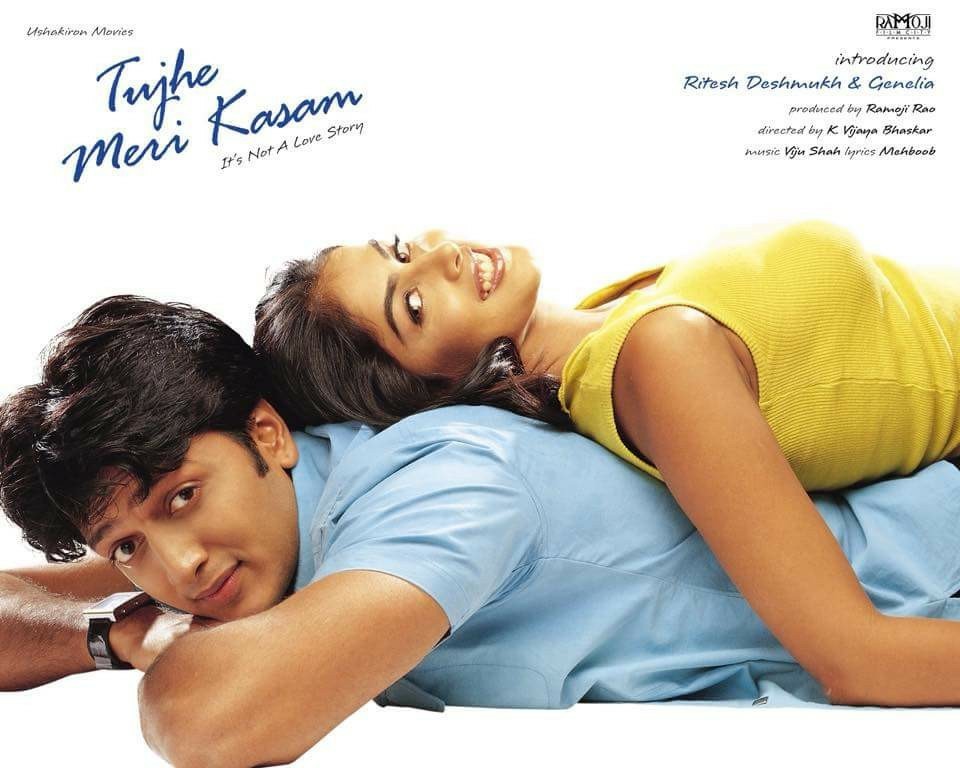
 in a new installment of This Day That Year, Subhash K Jha looks back at 2003’s Tujhe Meri Kasam. This is where they met and fell in love — Genelia d’Souza and Ritesh Deshmukh, one of the longest-lasting couples of filmdom.
Why must all couples-in-love in Hindi movies look like designer dreams? And why must their parents always be at loggerheads? Tired of watching Romeo and Juliet ‘s parents wielding the ‘weep’? Hindi debutant K Vijaya Bhaskar’s counter-syrupy love tale offers a welcome relief from lachrymose excesses. The peppy central romance is peppered with fatuous but cute campus colloquialisms, wacky one-liners and characters who are conceived as caricatural rabblerousers. There’s a girl called Girja who keeps tripping and falling all over the place. Gir-jaa, get it?
Neeraj Vora’s dialogues are the backbone of the bubbling broth. The stress in the spoken word is on an excessively aggressive abrasiveness. The youngsters constantly have a curt quip, if not a rude repartee, on the tip of their tongue. This makes them refreshingly different from the average tradition-bound dudes and dolls in the trillion tales of young love that have infested Hindi cinema since Dimple Kapadia asked Rishi Kapoor , “Mujhse dosti karoge?” in Bobby 30 years ago.
The new film on puppy love, tritely and wrong titled Tujhe Meri Kasam, is as far removed from Bobby as the debut-making pair Ritesh and Genelia are from Rishi and Dimple.
Ironically Ritesh is called Rishi in Vijay Bhaskar’s rapidfire outpouring of teen temptations. His best friend is Anju (Genelia) the girl nextdoor whose parents Satish Shah and Anooradha Patel (the latter best-remembered for her delicately poised performance in Gulzar’s Ijaazat two decades ago, making a welcome return). Rishi and Anju were born on the same day in the same hospital. They probably shared the same nappies and feeding bottle too.
So what’s the problem here? Nothing , and that could’ve been a problem for the plot. The pivotal pair have no cause for despair in the plot-less pilgrimage into puppy-dom. The hitch here is deliciously tempting. Like Kajol and Shah Rukh Khan in Kuch Kuch Hota Hai and Uday Chopra and Sanjana in Mere Yaar Ki Shaadi Hai, Ritesh and Genelia are best friends from childhood. When Rishi realizes his feelings for his childhood chum go deeper than friendship, he’s scared of confessing his love to his best friend.
And how can best friends be lovers? That’s the question which plagues this not-unpleasant flight into hands-off flirtation. To the debutant director’s credit he resorts to no corny crutches in this above-the-crotch-level tale of uncorrupted adolescent camaraderie. Stripped of all vulgarity and largely free of double-meaning dialogues, Neeraj Vora ‘s words give wing to the roguish machinations of the bratpack whose books are so unused, they house termites instead of enlightenment.
The film’s irreverence towards the supposedly sacrosanct institutions of education and love is its main charm and also its primary undoing. It’s hard to like these young people who spend all their time in counter-productive pursuits, pull each others legs, treat their parents with a closeted contempt and strut around as though there’s no tomorrow and certainly no yesterday. To these youngsters nostalgia probably means Kaho Na…Pyar Hai.
Fortunately the characters’ unstoppered abandon and cheeky iconoclasm never get out of hand. Sure these kids heckle their poor professor (Tiku Talsania) tick off their parents for meddling into their affairs and shoo off a veejay (Ruby Bhatia) with a barrage of rough rejoinders. But they’re well-meaning kids, noxious and not obnoxious. The narrative gets the difference.
Tujhe Meri Kasam gets bonus points for conveying youthful contempt for authority without making either the the senior generation or the progenies look like villains. Indeed there’re no villains in Rishi and Anju’s romance. Even the Other Man, Akaash with a vulgarly moneyed Dadiamaa (Susham Seth hamming blissfully in sync with the movie’s overblown mood) doesn’t grit his teeth even when Rishi and Anju snatch tickets for Kabhi Khushi Kabhi Gham from his hands and leave him standing in the foyer.
The script is well written and the characters are uniformly interesting in their burlesquing buoyancy. Supriya Pilgaonkar’s broadly-portrayed family-maid is specially appealing for its lowbrow comic candidness. The rest of the performers get into the trick of things investing their broad roles with a sense of pleasurable parody.
Howevever, an overall tackiness of presentation with sets , props and shot takings that scoff at basic aesthetic norms, take away considerably from the narrative’s trenchant characterizations and dialogues. Apart from an easygoing title song Viju Sha’s music is shabby and shallow. Kabir Lal’s cinematography adds to the prevalent sense of bourgeois inelegance that pervades this insouciant remake of of the Telugu smash hit Nuuve Kaavali.
Would the Hindi remake work as well? Though it lacks the basic glamour of the memorable love stories from Bobby to Love Story to Na Tum Jano Na Hum , Tujhe Meri Kasam works as a workingclass romance. The debutants Riteish Deshmukh and Genelia don’t look like they’ve just emerged from posh beauty salons nor do they project the picture-perfect charms of Hrithik and Kareena. Consciously or otherwise, they bring back the naturalness of Amol Palekar and Zarina Wahab from Basu Chatterjee’s comedies in the 1970s. But their clothes and dialogues are a dead giveaway.