
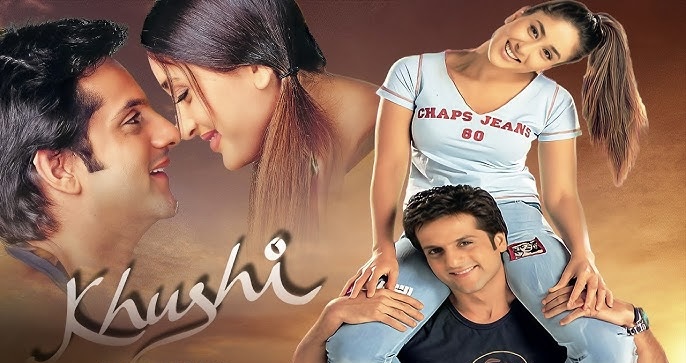
 Subhash K Jha revisits the Kareena Kapoor and Fardeen Khan romantic comedy, Khushi, which released in 2003, in a new edition of This Day That Year.
Khushi, which turned 23 on February 7, is a celebration of romance and music with two of the most startling lead performances seen in a film of this genre.
The sheer joy of watching Kareena Kapoor giving to her role the rich, supple hues of aggressive yearnings is joy enough. This time producer Boney Kapoor has more to offer than an extremely watchable leading lady who simply takes over the frames as though to the camera-born.
Khushi is a film providing multifarious pleasures all pouring out in a tumble of chic designs and svelte storytelling devices.
But hold on. ‘Storytelling’ isn’t the word to describe where Hindi-debutant S.J. Suryah takes us in this dulcet joyride. If you’ll look for a story in Khushi, you’ll end up scratching your head, and while doing so, you could possibly miss some of the devious give-and-take of bubbling banter between the egoistic couple Karan (Fardeen Khan) and Khushi (Kareena Kapoor).
“What’s this ego?” Khushi’s bucolic father (Amrish Puri) asks when Karan, unwittingly, offers his future father-in-law a lift.
Good question. Khushi is about the male and female Ego. And since an ego is as undefinable as… ummm, Kareena’s charisma, the film too leaves us perplexed for a definition. It’s also a film about a woman’s navel region and what havoc it could create when left exposed to the male gaze.
That the couple could get so worked up about the girl’s navel is part of the film’s innate charm and its exasperating intangibleness. We’ve seen innumerable boy-meets-girl films since Raj Kapoor’s Bobby. But none so urbane, witty, spiky, and saucy.
S.J. Suryah, who has made the same…er, story into major blockbusters in Tamil and Telugu, just lets the feelings flow out of the protagonists like unstoppered faucets. He neither forces nor coaxes the chemistry between the couple to hiss and crackle. The tremendous energy that flows out of the belligerent courtship is as intangibly definable as the magic that works between the two principal performers.
Kareena Kapoor once again proves she has no match on-screen. There may be other actresses who can do this or that better. But no one can do what she can. As the headstrong, bellicose, and constantly defensive Khushi, she fuses tender seductiveness with a resilience and joie de vivre that quite simply takes over the screen. In some key sequences with her screen dad (Amrish Puri) and with the man destined to be her life-mate, Kareena blends craft with intuition in a way that reminds us of Geeta Bali and Sridevi. If you watch her face closely in the sequence where Fardeen combs her hair in the hospital bed, you wonder what she could’ve done with Paro in Sanjay Leela Bhansali’s Devdas.
But the real surprise of Khushi is Fardeen Khan. After years of lethargic performances, Fardeen suddenly springs a delightfully bright, contoured performance. In all their scenes together, Fardeen matches his scene-stealing co-star to make a place for himself among the most endearing star-actors on the scene today. His body language in some places, for instance, when he shuffles to his car after pretending it’s broken down or when he tries to make Kareena say he’s her favourite person(she names Hrithik Roshan and Sachin Tendulkar), is truly a revelation.
Come to think of it, all along we’ve been looking at Hrithik Roshan as the perfect celluloid partner for Kareena, when in fact her chemistry with Fardeen is far more exciting. Here’s a partnership that’s pert, precocious, passionate, and captivating. Let’s have more of it, please!
Director Suryah harnesses the crisp collaborative energy between his lead pair to the optimum. The mating games are cleverly worded and filmed, though some of them (e.g., Fardeen’s drunken sequence in the dorm when he tears Kareena’s poster) overstay their welcome. And Johnny Lever’s takeoff on Asha Bhosle and Altaf Raja sets your teeth on edge. There was no need for extraneous humour when so much of that quality oozes out of the film’s protagonists’ aggressively egoistic attitude.
In a film displaying such fine technical skills, Marzin Tavaria’s editing is a wee choppy. Scenes that needed pruning are allowed to play on indefinitely, the exclamation mark making way for a question mark. At other times, scenes simply end without punctuation. The film’s other technical aspects are fresh, invigorating, and consistently captivating.
K.V. Guhan’s cinematography and Sabu Cyril’s artwork deserve special mention. They create a world of Arcadian joy and beauty without resorting to the Aditya Chopra-Karan Johar formula of aesthetics. The film’s sound design and Anu Malik’s music are outstanding. The songs, dear to the ear from before, come alive through the choreography. Two of the songs, ‘Ayee re khushi’ and ‘Do ajnabee’, are quite easily the most outstandingly choreographed rock-video styled picturizations in recent years.
Khushi at first unsettles you. We’ve never before seen a romantic couple doing the things Kareena and Fardeen do, and we’ll never again see a film quite like this. Better ones, worst ones, yes. But none like Khushi ever again.