
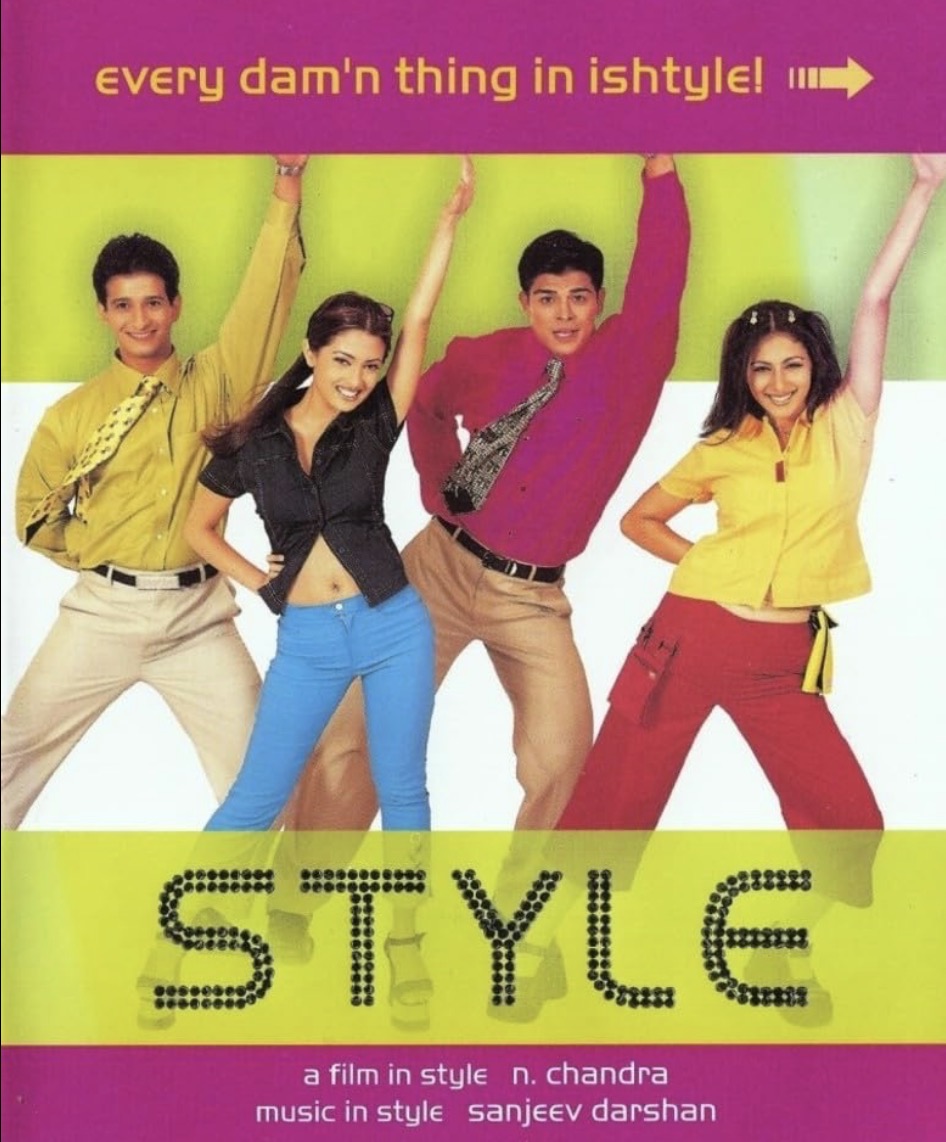
 Subhash K Jha takes a look again at Style, director N Chandra’s 2001 film that starred Sahil Khan, Sharman Joshi, Riya Sen and Shillpi Sharma, in this new edition of This Day That Year.
This film—if one can call it that—needs to be referred to the SPCA—Society For The Prevention Of Cruelty To Audiences. Director N Chandra made some of the most powerful entertainers of the 1980s including the raw and realistic depiction of joblessness in his debut film Ankush, the hardhitting look at brutalization in Pratighaat and of course the all-time musical drama Tejaab which proved to be Chandra’s acid test.
The 1990s witnessed a complete erosion in Chandra’s creative powers. All his post-Tejaab works including Yugandhar, Narasimha , Humlaa and Beqabu were crashing failures.
In this millennium, Chandra re-invented himself as a ‘young’ director. Style, as his anything but stylish farce is called, selects four youngsters, one of whom (Sharman Joshi) has been seen earlier, and puts them in a campus comedy that combines the style of David Dhawan with the mood of Hollywood’s chic teen-flicks .
The end-result? A crashing bore and one of the worst written edited and enacted films of 2001. What’s specially tragic about Style is its utterly arid comic sense. For a film that relies on youthful guffaws for effectuality the purported humour is as flat as our two unlikely heroes’ chests when they aren’t posing as women at a girls’ hostel.
The men-in-drag theme, done so comically by Rishi Kapoor and Paintal in the 70s’ comedy Rafoo Chakkar, simply drags. In trying to be cutely vulgar Chandra is way out of line, causing more pandemonium than parody in his infantile plot. The outright crassness of the material shocks us as it indicates the rather abrupt end of the road for one of the more influential filmmakers of our times.
Chandra’s chirpy protagonists Chantu (debutant Sahil Khan) and Bantu (Sharman Joshi) are blatantly and crudely inspired by David Dhawan’s Munnu (Govinda) and Bunnu (Chunky Pandey) in Aankhen. They are a work-shirking, unethical and indisciplined extreme respresentation of aimless youth.
While Chandra is at liberty to subvert his own serious and thoughtprovoking theme of unemployed moorless life from his debut film Ankush, he has no moral or ethical right to rob his cinema of all aesthetic sense.
In one sequence, Chantu and Bantu bathe together(as they’re shown doing everything else together) while their girlfriends Sheena (the legendary Suchitra Sen’ s grand-daughter Riya Sen) and Rani (Shilpi Sharma) wait outside munching on the oranges that serve as the two prankish protagonist’s artificial breasts for their drag act.
In spite of all the mammarian mirth between the bosom pals Style lacks heart. The whole crass act is implemented as a ploy to generate mass appeal as the two protagonists’ go about their mission to become “rich” by wooing two heiresses (again a narrative device borrowed from Dhawan’s Aankhen). Sadly, the film ends up at the place where Chantu and Bantu find themselves: the garbage heap.
A dramatic core is invented through the character of the female villain (Tara Deshpande) who subverts the land’s anti-dowry laws to steal her in-laws’ inheritance , and uses men to satiate her quenchless craving for money. Deshpande’s character could have been an interesting effort to extend villany into feminine domain. Instead she’s projected with exasperating lack of subtlety and basic intelligence.
N. Chandra’s narrative is cluttured with third-rate dialogues songs and dances which proudly draw attention to themselves by being brazenly tawdry. The exceptionally unbefitting girls and boys in the lead are never separated from one another. A humid claustrophobic atmosphere hovers over the plot with depressing persistence .
The surface gloss and the tiresomely reptitive gags representing youthful vitality at the tackiest and mos primeval level , are artificially and gracelessly induced. The ear-splitting vulgar music score by Sanjeev-Darshan, cornily kinky characters. (such as the watchman at the girls’ hostel who ‘s a closet-peepingtom) and the broad eye-rolling performances add to the film’s atmosphere of obscene merrymaking.
We won’t even go into the values and ideologies that Chandra tries to project in Style. But what an inglorious end to Hindi cinema in 2001!