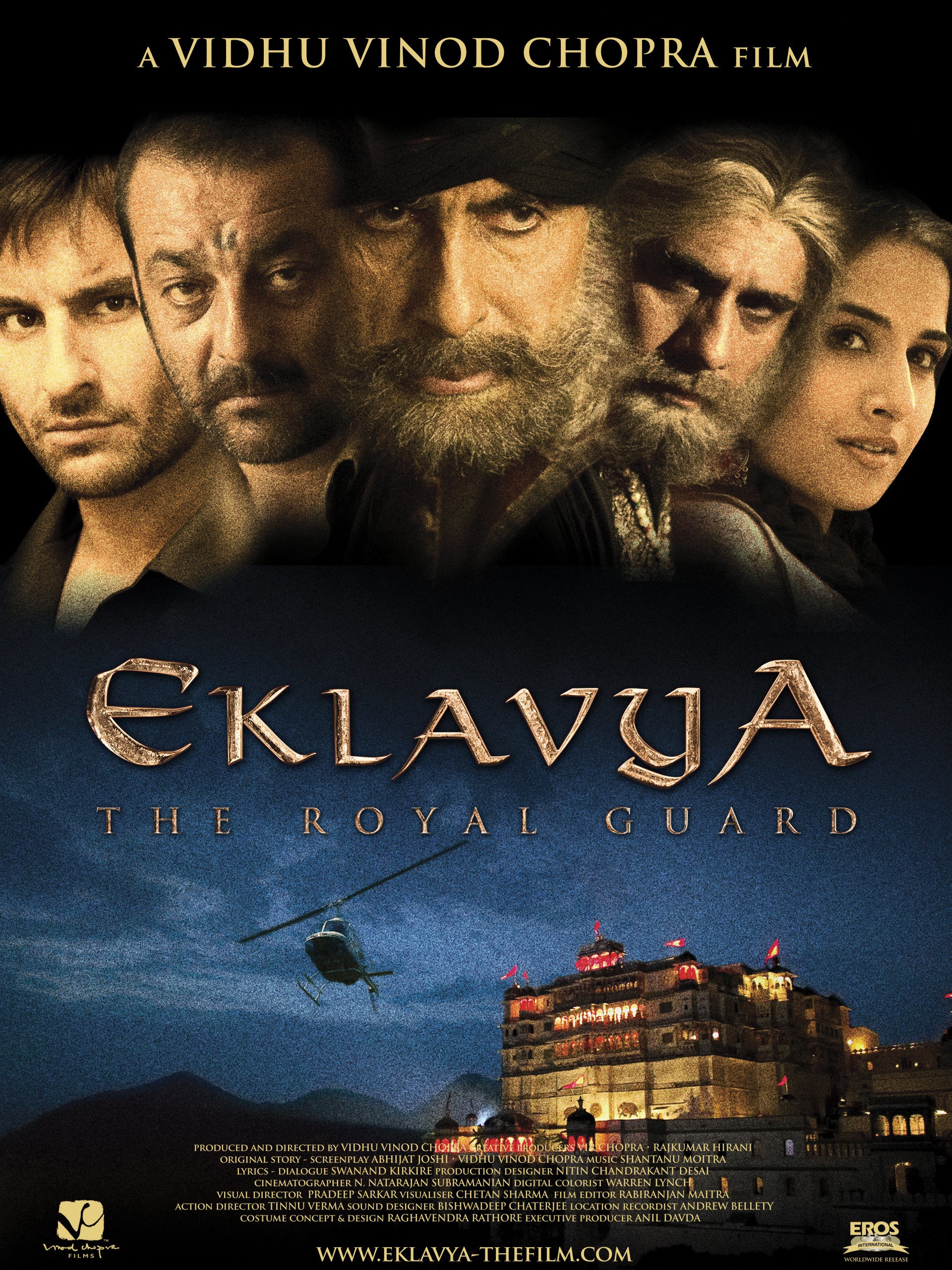
 Subhash K Jha, in a new edition of This Day That Year, looks back at 2007’s Eklavya: The Royal Guard, directed by Vidhu Vinod Chopra that featured the incredible cast of Amitabh Bachchan, Saif Ali Khan, Sharmila Tagore, Sanjay Dutt, Vidya Balan, Raima Sen, Jackie Shroff, Jimmy Sheirgill, and Boman Irani.
Some stories are better left unsaid. Eklavya: The Royal Guard tragically seems to belong to that rare genre of stories that lose their relevance in their rendering. The characters, all ruefully rooted to a decadent and dying aristocracy, are either neurotic, manic, or self-destructive.
Can form, no matter how glorious, be a substitute for content? In Eklavya, lack of content isn’t a problem. It’s the tense and dark nature of the content that proves to be a dismaying impediment to enjoying the virility of Vidhu Vinod Chopra’s storytelling.
How do we define the plot of Eklavya? It partly borrows the dark, indefinable pathos of Shakespeare’s tragedy and partly reverts to the palatial pathos of the Mughal Empire, where patricide frequently collided with complex Oedipal equations. Eklavya takes us into a territory totally unexplored and designed to create an ethos of infinite resonances.
Eklavya is a film of many virtues. Screenwriter Abhijat Joshi and Chopra aim for a sense of heightened tragedy that underlines the cinema of Kurosawa and the music of Mozart. The quality of the sound design (Biswajit Chatterjee), background score (Shantanu Moitra), and cinematography (N. Natarajan Subramaniam) elevates the bizarre tale of a dysfunctional royal family to heights of lyricism.
All the people who crowd the tightly cordoned stratosphere of Eklavya are grandly wedded to destructive forces. Unwittingly they end up looking preposterous in their self-conscious postures of assumed dignity.
In their inability to see beyond their own hefty hunger for self-assertion, the characters often mimic, rather than replicate, the Shakespearean tragedy.
Chopra is undoubtedly a master craftsman. At times, he becomes self-indulgent in his visual panache. In the sequence where Eklavya slaughters Jimmy Shergil, the recurrent pigeons-leitmotif (seen earlier in “Parinda”) are classic Chopra embellishments best left behind in a film that in many ways crosses the boundaries of mainstream conventions.
Indeed, if Vishal Bhardwaj’s Omkara was more Ram Gopal Varma than Shakespeare, Eklavya is more Virginia Woolf than Shakespeare. Chopra is brilliant at capturing neurosis through the lens of the camera. At times he makes room for tenderness. Watch Bachchan’s expression of tender nostalgia as Vidya Balan sings the ancestral lullaby.
You often see the characters framed frantically as wounded, scarred mortals hurtling towards their ruin – they do not connect with us in any significant way.
Reciting Shakespearean sonnets on death-beds, sobbing into the night, stabbing each other in their aristocratic backs, playing mind games that echo the travesties of titular existence, Chopra’s people come alive more through their externalities rather than his efforts to internalise their angst.
Chopra spares no effort to penetrate the steely, wily hearts of these bereft souls. Rajasthan is captured in telltale silhouettes as the stately royal guard Eklavya (Bachchan) forms a fertile bond with a family of doomed aristocrats.
The narration begins as a mother-son story and builds with magical volition into a father-son tale of clenched trauma. By the time Eklavya points a gun at his own heir-apparent, we are left looking at a family that doesn’t need redemption. It just needs to be buried in the slinky sand dunes of time.
The performances by Mr Bachchan and Saif Ali Khan – the royal heir who finds out that the family guard is actually his father – lift the tale to luminous heights. Boman Irani, as the infertile royal patriarch, plays his character with just that shadowy hint of mischief that puts him a cut above the routine slime-ball.
Eklavya is a chronicle of defeat. People who belong to no specific time zone seem to be manoeuvring their lives beyond the rhythms of the rationale. There’s poetry in the soul of the movie. But the lines do not represent any significant symbiosis of form and content.