
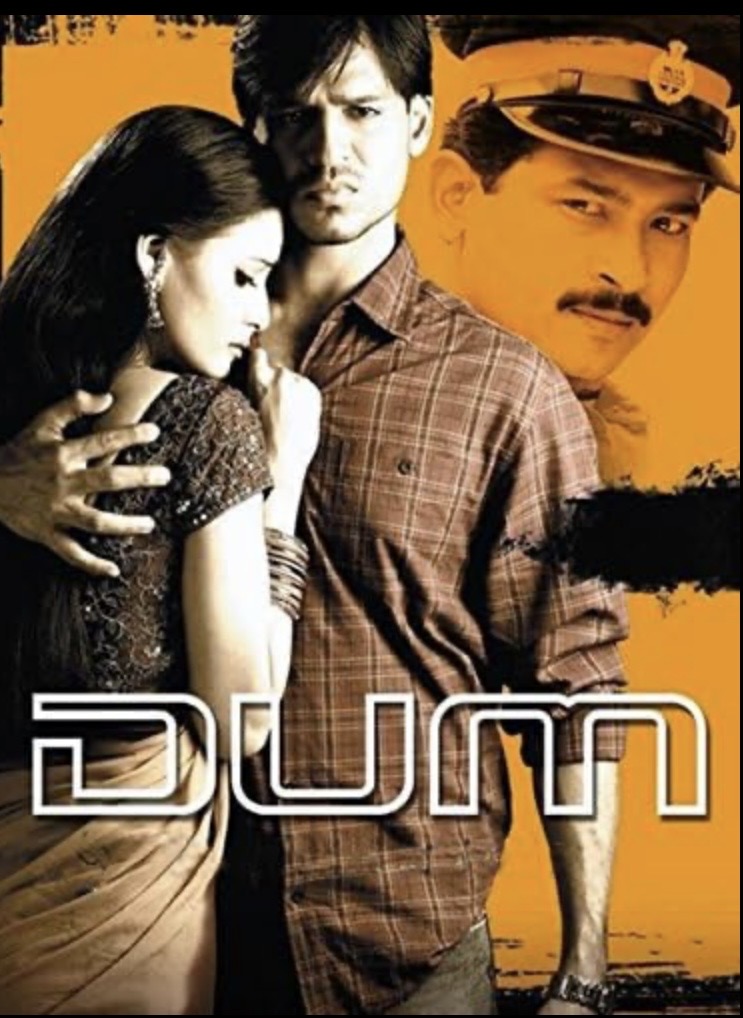
 In another installment of his feature series This Day That Year, Subhash K Jha revisits E Niwas’ Dum which starred Vicek Oberoi, Dia Mirza and Atul Kulkarni.
A corrupt cop barges into an honest colleague’s home and tries to gas his wife to death. When she escapes, the fiend kills the cop’s little girl instead…. A brainless assassin chases an honest politician through a vegetable market and cuts him up like chicken (in fact, the sequence opens with a butcher chopping up meat)…. The aforementioned corrupt cop beats the young protagonist black and blue and then ties him to a railway track to make sure he dies a painful death….
These are just three of the harrowing sequences of street violence that cut through E. Niwas’s third feature film with the swooshing professionalism of a butcher prying into a troublesome turkey at Thanksgiving.
If Kucch To Hai (which released the same week) is a comicstrip, Dum is a newspaper report. Grim, dark, traumatic, and yet on some level, thrilling. Subconsciously, the working-class hero’s fight with a corrupt law enforcer offers us the same gratuitous comfort as the report from Bihar last month about three young innocent men in Patna being gunned down in a police “encounter.”
“Thank God it isn’t us,” we mutter under our agitated breaths as Niwas’s protagonist Uday Shinde (Vivek Oberoi) takes on the immoral might of a villainous cop Shankar (Atul Kulkarni), a human-being(?) so degenerate and debased he makes Sholay’s Gabbar Singh seem like a comicstrip character.
There’s nothing bright, colourful, uplifting, or comforting about Dum. If you regard cinema as a form of escapist entertainment, then Niwas’ ever-grim film is a no-no. However, if you regard cinema as a mirror of social reality, then Dum is a hard sock in the jaw.
Dum bludgeons you with a cyclone of splendidly staged violent encounters. Human brutality in all its splendour has been depicted with such vividness only in the films of Raj Kumar Santoshi. Niwas seeks inspiration from both Santoshi and his mentor Ram Gopal Varma. The film’s theme of the brutalization of the youth force also harks back to Rahul Rawail’s Arjun. Vivek Oberoi is a more believable working-class hero than Deol. His bourgeois face reflects a steely determination to overcome his innate socio-economic shortcomings. His breakdown sequence, done in a tight closeup in the hospital when his best friend dies, is unforgettable.
The fight with a corrupt and reprehensible establishment looks more credible than in most recent films dealing with the subject. Finely crafted and extremely violent, Niwas moves through the streets of Mumbai like a panther on the prowl. From the opening scenes where we see Vivek Oberoi chasing Sushant Singh through the narrow telltale bylanes of Mumbai, we’re hooked to the goings-on.
Even as he crafts his scenes with a diligent dynamism, Niwas leaves room for the tensions to grow from within the plot. In his endeavour to combine craft and intuition, the director is generously aided by Surendra Rao’s cinematography and R Varman’s art direction. Both the technicians till the film’s landscape with a passionate plough. The individual sequences depicting the conflict between the heinous lawman and a young man stepping into the thoroughly subverted police force work both as a taut cops-and-robbers thriller as well as a parable on corruption in our country. On both levels, the film scores a stylish sixer .
Many of the sequences are framed with an in-your-face aggression. The striking theme song with balls of fire emanating from every corner of the frame ends with Oberoi hurling his booted leg towards the camera. The tone of unrelenting aggression as Oberoi’s Uday Shinde matches wits and wallop with his terrifying adversary begins to get oppressive after a point. Except for a few shared moments with family and friends and a discreet romantic interlude with the fresh-faced girl next-door (Dia Mirza), there’s no cheer in the protagonist’s existence
Dum is like a sullen cloudburst clamping down on a tightly cordoned area of starkness. Three years ago, in his unevenly paced, technically shoddy debut film Shool, Niwas had portrayed a Zanjeer-like cop‘s fight to finish corruption. Today, the subverted law enforcement agencies of the country demand a new cinematic moral code. Niwas upturns the battle between good and evil by portraying the khaki –clad individual as the fulcrum of degeneration.
Atul Kulkarni so brilliant as the ganglord with a heart of gold and a loin in heat in Chandni Bar is a snarling symbol of contemptuous corruption in Dum. His villainy is a step forward in the way evil is portrayed in commercial cinema. Vivek Oberoi is controlled and in-command. Unlike Saathiya where he often strained for effect, here his character’s anguish flows more effortlessly.
The film adheres to the two character’s viewpoint. And apart from one aggressively done ‘item’ song Sandeep Chowta’s music and songs are well integrated into the plot. Though there are some interesting incidental characters(like the street hawker who refuses to give away the protagonist’s identity during police torture, and a gay television-serial writer, played by Vivek Shauq and his omnipresent sidekick) none of the peripheral players get a prominent voice. However, that gifted actor Sushant Singh makes space for himself. His death scene is one of the few moist-see points in an otherwise staccato–mooded narrative.
Sandeep Chowta’s background music and songs largely complement the quicksilver thriller-mode. We never know which way the crooked will crumble, and, given the present-day scenario of debauchery and corruption, whether Good will finally conquer Evil. That it does finally happen in Dum takes us by surprise. And that’s the film’s biggest triumph.