

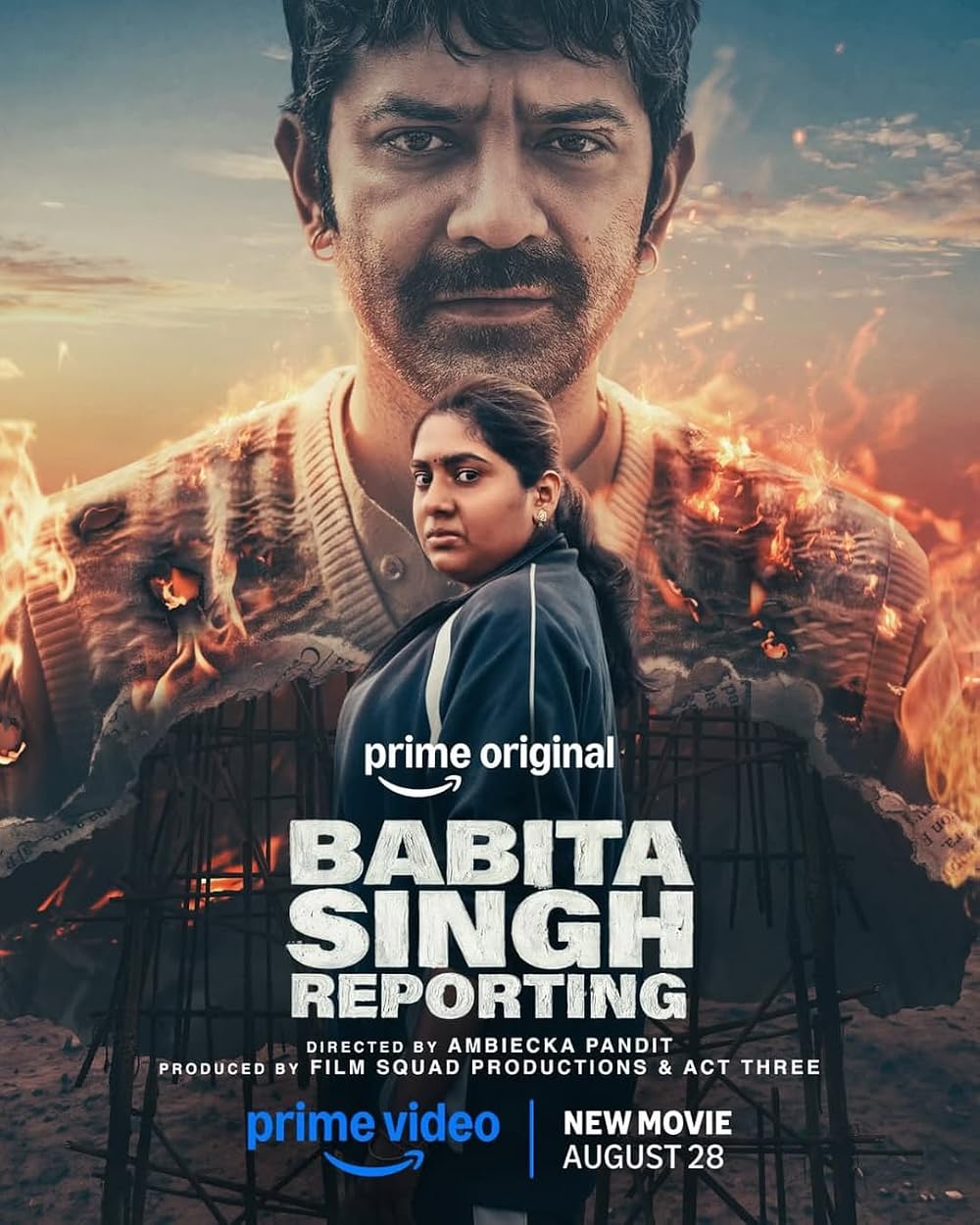
 Amazon Prime’s spindly yet sturdy exploration of a woman, a wife, and a career woman’s dangerous leap from submission to self assertion, is not only an engrossing experience, it is also life-changing, at least for the protagonist Babita, a k a Baby(though I suspect she doesn’t like to be called that) who, by the end of the gripping and clenched film , is a different person from how she started.
How Babita finds her groove is a far more interesting journey than the police investigation she takes on while visiting her in-laws for the first time for a gode-bharai ceremony. Ironically, Babita has not been able to get pregnant. All her husband’s fault. It always is in such a film.
Babita’s brush with outlaws while visiting her in-laws is most certainly not uninteresting. But what really gives credence to the police procedural is Babita’s obstinate resolution to find her groove as a wife and a professional while seeking a solution to the murder of a childhood friend.
The dead friend Bansi is played by Barun Sobti, who is the kind of virile character-assumer who can leave an impression in just a few scenes. This is what he has done, playing the murdered man as a kind of roguish Rebecca in a dusty town of Madhya Pradesh where they haven’t even heard of Rebecca.
Babita is visiting Rewa with her husband Sharad, the kind of working-class husband who would be designated liberal by the people around him. He “allows” his wife to be a working woman and “doesn’t mind” marrying Babita in spite of her being from a lower caste.
Sharad constantly body-shames his wife in front of his family. Everyone laughs. Such spousal behaviour is considered normal among the people that this angry film inhabits with such casual fluency.
Not everything works equally well—I was left dissatisfied with the murder denouement, and perhaps that was the screenplay’s intention. But whatever the rough spots, Vijay Sajayan irons them out. Her crumpled clothes and smoothened determination to find her bearings in the chaos of her husband’s family, are persuasive.
Sajayan is compelling as Babita. The emotional heft that she brings to the character is frequently matched by the physical strain the character has to go through in order to be far more heroic than she is equipped to be.
In one sequence, she has to jump over a wire fence; I found myself wincing with her. It is a dedicated, starkly honest fearless performance that immediately elevates the film by leaps and bounds.
Director Ambiecka Pandit is best when capturing the cloistered, casual toxicity of a small North Indian town where prying is considered to be a concern, and callousness is deemed sensible. But I wish the film had avoided some of the spousal stereotyping: why does the man have to heave joylessly on top of his wife in bed each time a woman directs the show?
Why is sexual gratification, and the lack of it, an integral part of the Shero’s journey into self-awareness? In her most celebrated role as a dissatisfied wife in The Great Indian Kitchen, Nimisha Sajayan was heard requesting her husband for some foreplay.
Here, she isn’t even asking.