

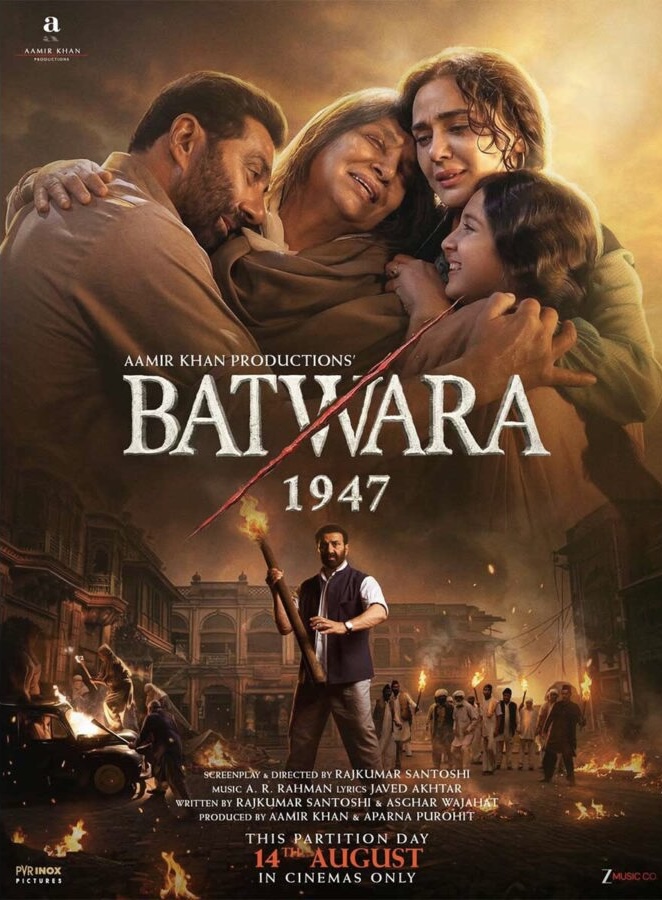
 It is very rare to see a film these days which tells you not to hate the other community and to look for the enemy within. In Ms Sathyu’s milestone classic on the Partition, Garm Hawa, there was an old lady who hid in the kitchen because she didn’t want to leave her home.
Mai, the character that the great Shabana Azmi plays, is an extension of that briefly but vividly etched character. After all these years, I haven’t forgotten that character. I don’t think I will forget Mai either: stubborn, playful, generous and clever, Shabana Mai just steals our hearts. The actress deserves another National Award for this performance.
As for Sunny Deol, he has grown into a formidable actor, far ahead in nuanced characterization than all his contemporaries. His portrayal of Sikandar Mirza seems like a direct descendent of Balraj Sahni’s Salim Mirza in Garm Hawa, migrating into mayhem from India to Pakistan during the carnage in 1947, only to find himself fighting to protect an old Hindu woman in Lahore who waits endlessly for her(slain) son to return home.
The bonding between Deol and Azmi is indescribably poignant. They are separated by religion but joined at the hip by an invisible umbilical cord. Oozing empathy, Deol’s love for his adopted mother reaches out of every frame.
The message here is not broadcasted from rooftops. The bonding of empathy and the hero’s adamant resolve that humanism comes above religion, resonates across the film with a feral intensity. I don’t think Sunny Deol has played a more heroic character in his entire career. This is a man who won’t let an old woman be hurt by mobsters just because she is in the wrong community.
What lines Deol has been given to speak! The intermittent introspections on humanism and communal harmony never sound like pulpit prattle. Deol assumes the right to spread the opposite of hatred as though by birthright. He is as mellow as a river’s running water which does what it does simply because it has to.
Some of the supporting cast is pointedly caricatural, specially the villainous Yaqoob Pehelwan (Abhimanyu Singh) who grimaces and smirks as if practising for a play on parodied perversity. On the other hand, there is Ali Afzal as a mysterious poet and benefactor.He is gentle and wry. He has one lengthy sequence with Shabana Azmi in a dimly lit street of Lahore where he tells her why she mustn’t leave town under pressure.
That moment hits us hard. I longed for more productive conversations among the more enlightened characters of this fascinating study of the urge for transcending communal divides. The climax is so sublimely inspiring I clutched at my heart to make sure it doesn’t break.
Batwara 1947 is Raj Kumar Santoshi’s best , most relevant work since Lajja in 2002. He has worked a magical alchemy with Sunny Deol in the past, but nothing to compare with the irradiant validity of this work.
We may not find every component of this peace anthem equally harmonious—and Rahman’s atonal Bhajan is the worst I’ve heard in cinema—but at its core this is a work of tremendous integrity.