

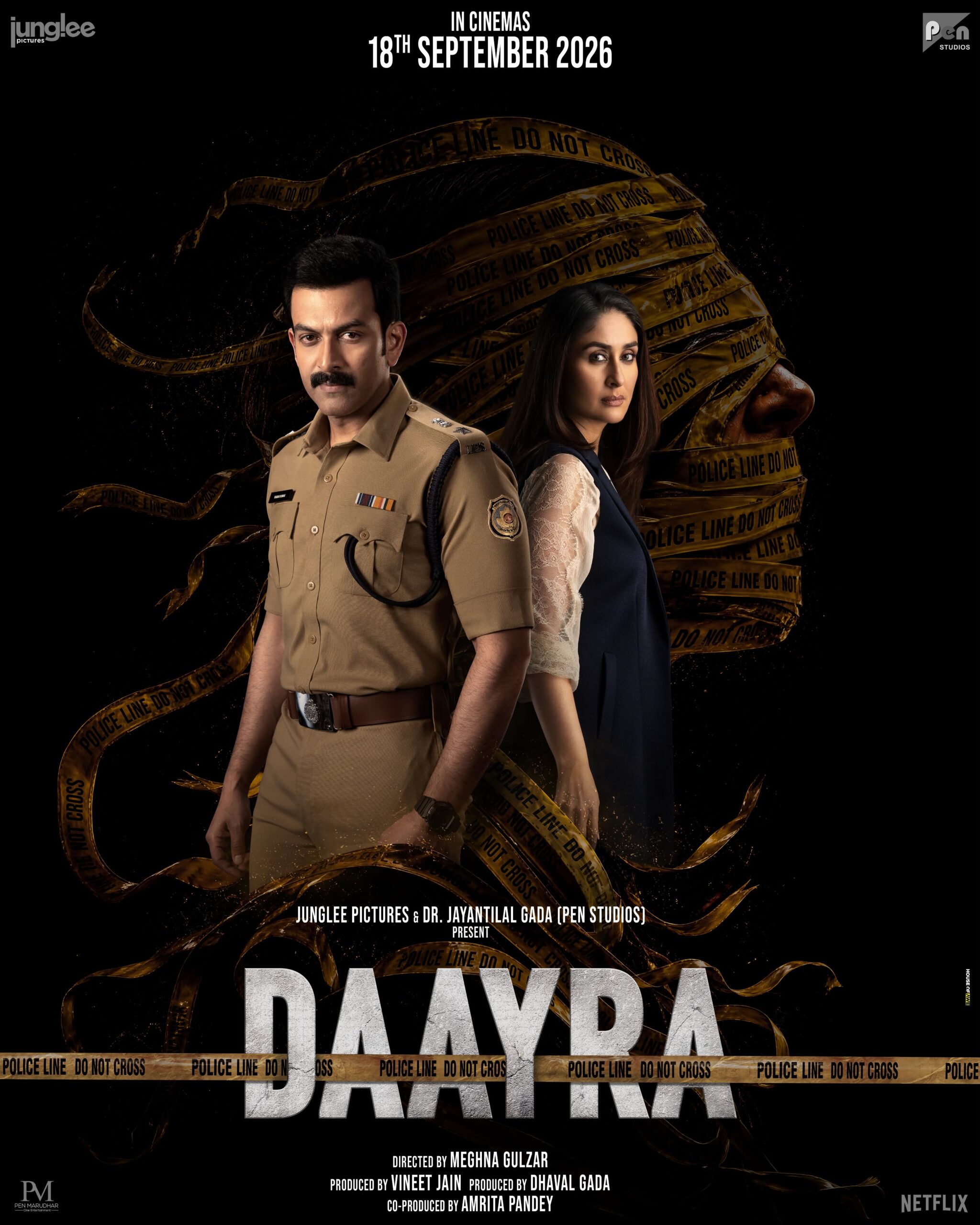
 The law will take its course… is a line used in the film with much irony.
We all know what happens to the lawbreakers while the law does its lawful thing. Biryani and furloughs come to mind.
In the meanwhile, a working girl on a scootie goes out into the night to get her kid brother’s glasses. She never comes home. Silly girl! Didn’t she hear what the politicians have to say about girls who step out into the night?
How many times have we seen the indifferent, abrasive cop at the thana acting nonchalant and impatient as the parent panics and pleads about a missing child? I remember the one in Anurag Kashyap’s Ugly. I thought no film could beat that when it came to police apathy.
Meghna Gulzar has proven me wrong. She takes the police procedural by its stained khaki collar and drags it into an area of ambivalence where the question of justice appears so tenebrous, it screams for a resolution that the incisive screenplay (Meghna Gulzar, Sima Agarwal, Yash Keswani) refuses to provide.
As in Sagar Sarhadi’s Bazaar, the final moral resolution is left to us. We can’t look away.
There is no comfort of an unequivocal resolution here, a fact that’s reiterated by Gulzar’s song at the end of the film. Right and wrong jostle for space in Meghna Gulzar’s tormenting treatise on gangrape and murder.
Apparently based on an incident that happened in Hyderabad some years ago, Daayra resolutely refuses to play the righteous card. As two cops, one who works within the radius of the law and the other who believes the lawmaker’s work extends to execution, Kareena Kapoor Khan and Prithviraj Sukumaran bring in a certain unsettling poise, a sense of harnessed turmoil, to their characters.
Anjooni Kohli and Raman Kumar are put under acute pressure, saddled as they are with the task of defining the boundaries of justice, and yet remain miraculously afloat in a universe rapidly sinking into bestial immorality.
The rape victim’s mother (an absolutely devastating Kshitee Jog) puts the tragic inevitability of crime passages in contemporary societies, in a nutshell, when she tells the stoic Raman Kumar that the struggle for justice begins, and not ends, after the culprits are arrested.
This is one of my favourite moments in the freefalling narration. Raman Kumar suggests the bereaved mother and her son move to another place to avoid prying eyes.
“Why should we be hiding? We haven’t done anything wrong,” says the raped and murdered girl’s mother, grappling with the why-me syndrome. The moral nakedness of this statement is far-reaching. And yet Meghna Gulzar, for all her throbbing concern for justice, never leans into the widening sentimentality of the mother’s grief.
Is there any closure for tragedy of such enormity? Can any punishment really be enough? What makes the dramatic tension of the tragic scenario so palpable is its dilating dimensions. Somewhere in the second half, the idea of a juvenile criminal getting away with murder (and rape) is insinuated into the pulsating tension of the drama that goes easy on dramatics.
Ideating slotting or labelling the tragedy is never on the cards here. Seeking a moral center to the crime is. A centre that becomes more unreachable the more you try to get there.
Megha Gulzar is no stranger to the world of real-life crime. She did a fine job of unravelling the snarled threads of a young girl’s murder in Talvar. A young girl also dies brutally in Daayra. But the world around this crime is far more unidentifiable, extended, and boundaryless. And therefore much more difficult to pin on film.
Daayra gets it right most of the time. It deals with a complex moral issue with scrupulosity and sensibleness. There is no room for humbug in the narration. Every actor, even in the smallest parts, is uncompromising, even when playing monstrously compromised characters.
What is truly admirable here is the varnished intentions of the narration. No one is in this for the thrills. It feels so much like life, and not in a pleasant, comforting way. And yet it is a voice that must be heard.