

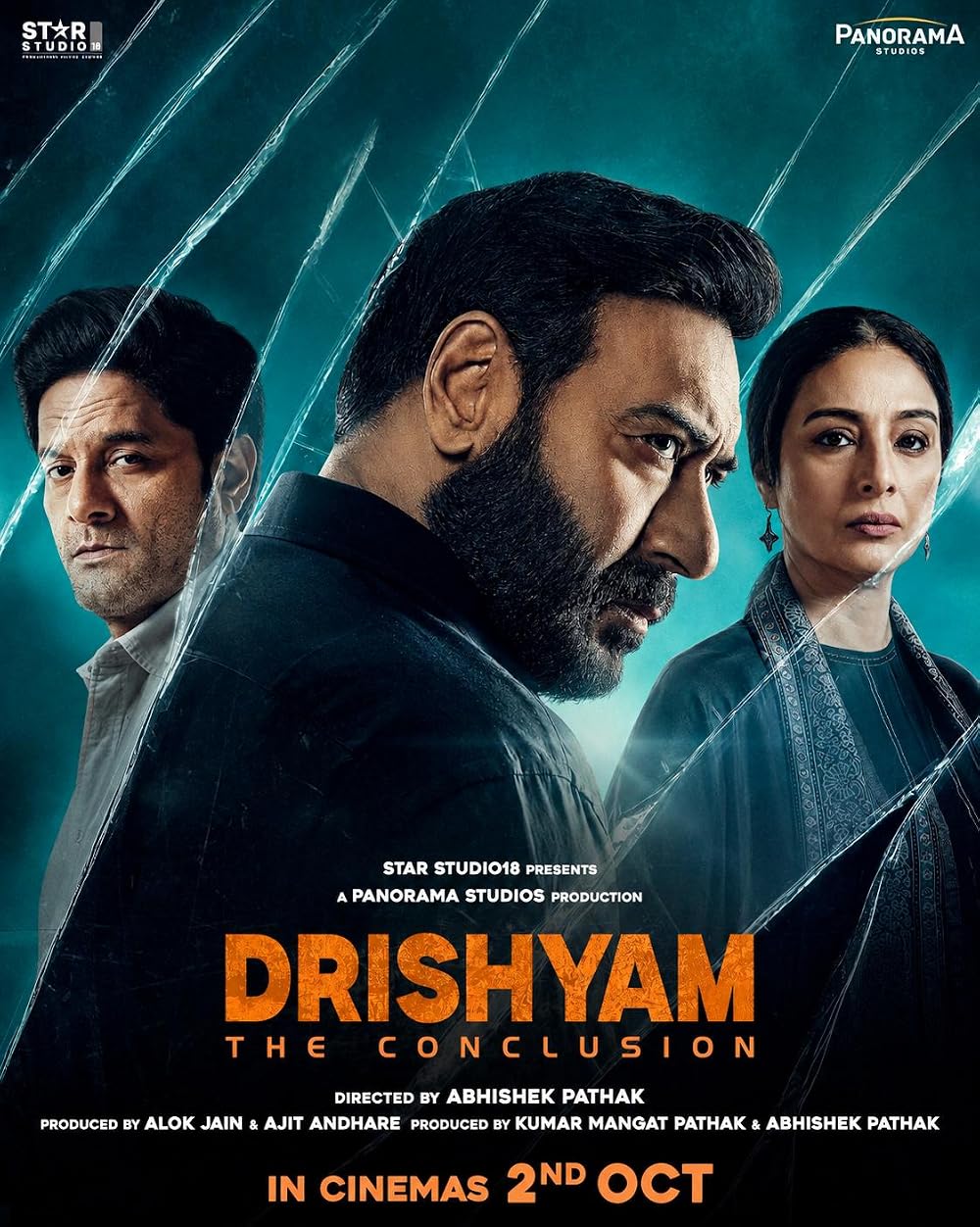
 First things first. That Jaideep Ahlawat is in and Akshaye Khanna is out is one helluva stroke of luck for the third, blessedly final chapter of Vijay Salgaonkar’s hoodwink-the-law-until-it-hurts saga.
Or Getting Away With Murder, Freefall Style.
The only truly redemptive arc in the progressively far-fetched drama is the one provided by Ahlawat whose performance transitions from Khanna’s jaw-twisting to jaw-dropping. Many of the best portions of the not-so-grand finale feature Ahlawat centrestage while Devgan does the heroic equivalent of wringing the hands, not so helplessly. The wicked stealth with which Ahlawat’s khaki intruder disrupts Salgaonkar’s daughter’s wedding discussions, is a masterclass in manipulative screenwriting(not to mention, a pitch for jalebis as a adrenaline booster).
Not all of this film is as smart. Some of it is purely aspirational , trying to be suspense-heavy and toppling over in the effort.
Ahlawat’s chain-smoking (unlike other actors shown with the cancer stick, Ahlawat really inhales, and that goes well with the overall authenticity of his character’s construction) SP Rajveer Singh Tomar has some of the best lines in the third part.
In some sequences Devgan is just a spectator in the courtroom which is very sporting of him. Of course Devgan’s Salgaonkar gets the last laugh… again! Grave matters indeed.
I came away with a sense of underwhelming closure in a drama of stymied morality which never really stood up to its own audacity. The basic line of argument—how far would you go to protect your family—gets progressively drowned in the din of stylized suspenseful semantics .
The over-dramatic background score (Amar Mohile) does most of the emotional heavy-lifting. The sequences, framed in a feral dramatic images, are over-punctuated by the background score which seems to scream at us for attention.
Throughout the play of justice-versus-revenge most of the characters remain tight lipped in a way that suggests they have much to hide. Watching Devgan’s taciturn turn, I am reminded of what Shakespeare said about those who speak austerely having nothing much to say.
As for Shriya Saran as Mrs Salgaonkar, her expressions of concern and her accented Hindi, suggest she is more worried about the chicken in the kitchen getting over-cooked rather than her husband facing a long prison term.
Ironically, while Salgaonkar makes secrecy and reticence his weapons of defence, Tabu as the mother seeking revenge too remains largely tight lipped, while the cops and the lawyer(an over-the-top Prakash Raj) do all the yapping, some of it surprisingly clever.
Ultimately, the narrative trips over its own smartness. The denouement is so strenuously spun it feels like an uneasy closure combining cockiness and community outrage. When skeletons in the cupboard, move to the graveyards and then get dug up for plotting convenience it is time to remember, Agatha Christie never considered alibis in the same light as Vijay Salgaonkar.
I also had a problem with Murad, the screenplay writer, played by the normally dependable Saurav Shukla, who reminds us that truth is often stranger than fiction, when in reality he means the opposite.
Drishyam The Conclusion is not a bad film at all. Some of it, featuring Jaideep Ahlawat, convey a pungent slow-burn aroma. But the stubborn silences of Salgaonkar and the smirking smugness of his accomplices prove that crime in certain circumstances not only pays , it also clamours for a re-fund.