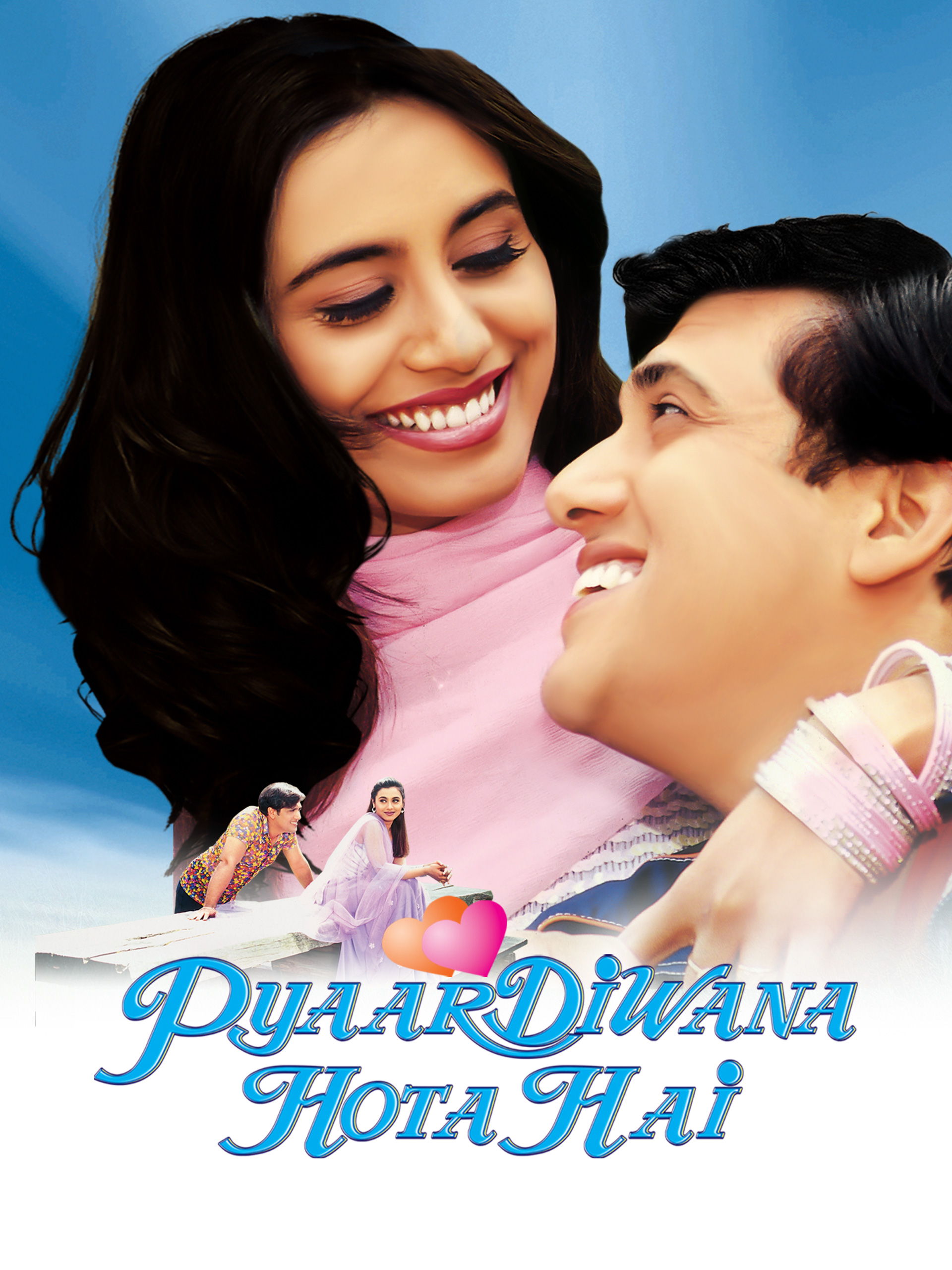
 Subhash K Jha takes a look back at 2002’s Pyaar Diwana Hota Hai, which starred Govinda and Rani Mukherjee.
After a spate of flops, Pyaar Diwana Hota Hai did nothing to rejuvenate Govinda’s sagging career. And how could it, when the film’s weird mixture of mirth and morbidity proves a nerve-wracking experience for the audience?
There are two main categories of films. Those that enlighten and those that entertain. Some do both, while the rest do none. Pyaar Diwana Hota Hai falls under the ‘none’ category. It’s a strange story about a small-town boy, Sundar (Govinda), in Mumbai, whose only mission in life is to get a girl to smile and speak to him.
His three enormously irritating (and not the least entertaining) flatmates (played by Deepak Tijori, Laxmikant Berde, and Kishore Bhanushali) give Sundar misleading tips on how to achieve his amorous dream
For about half an hour the film’s gross humour and loud, screechy characters prevent any coherent interaction between the narration and the audience. Director Keerti Kumar (who earlier directed his star brother Govinda in a couple of equally floundering fiascos) all but loses his audience at the outset, but somewhat recovers lost ground when Govinda meets the culture vulture NRI Payal (Rani Mukherjee), who’s come back home to study Indian classical dancing.
Someone should seriously study the new trend of NRI heroines coming down to India to do some scratch-level social analysis. We saw Kareena Kapoor and Amisha Patel doing the same in Mujhe Kucch Kehna Hai and Kranti. Now it’s Rani’s turn. Director Keerti Kumar’s affection for “classical” Indian culture , evidenced in his earlier film Radha Ka Sangam, surfaces in the drizzle of mudras and rasas that Rani’s character encounters in the course of her ‘research’.
Then she meets the thrill-seeking Sundar, who wins her over with his dumb act. Sundar is never very sure whether she sympathizes with him because he pretends to be mute, whether she ‘s fascinated by his dumb charade because of love for classical Indian dancing, or has she fallen in love with the simple, small-town naïve who decides to act dumb to get the girl’s attention.
Such questions do not obtain easy answers in a film that pertains to be a cross between a sitcom and an Italian soap opera and ends up being neither. In principle, Sundar’s dumb charade does appear to be a pleasing pretext for rib tickling moments. And, in fact, there are some amusing moments in the narrative specially when Sundar with his Gujarati hoarding–painter friend (Johnny Lever) goes to Payal’s house to watch cricket match on her television.
But genuine laughter is hard to come by in this comedy of unforeseen tragedy. Towards the finale, the film suddenly acquires an alarmingly morbid complexion typical of Tamil-Telugu melodramas, but rather strange and strained in a Hindi-language comedy.
The ridiculously sentimental ending has our lovelorn modern-day Devdas behaving like a complete ass. When Sundar insists that the ENT specialist called Puri (played by, surprise surprise, Om Puri) surgically remove his powers of speech, we are rendered speechless. When Sundar lunges for a pair of surgical scissors in Dr Puri’s office and severs his tongue, we are tongue-tied. And when he offers his tongue-less state as proof of undying love, there’s no love lost between the character and the flummoxed audience.
Keerti Kumar (Govinda’s real brother) probably set out to make a legendary love story. What he has on his hands is a farce of epic dimensions. The film’s prolonged production schedules take their toll in expected and unexpected ways. While Govinda remains consistently podgy, Rani Mukherjee goes from slim to overweight without a burp. Their performances are not so bad considering how pathetically handicapped they are by a preposterous plot and a slapdash narrative style.
Some sequences, such as the one where Sundar takes his three friends to a scenic spot to reveal his traumatic childhood, are designed to exhibit Govinda’s range as a non-comic, dramatic actor. With audiences sniggering non-stop at the film’s purported drama Govinda doesn’t stand a chance. The rest of the cast are hazy, lazy blurs in a blotched and bleary landscape. Even the credit titles are carelessly done with several names being glaringly misspelt.
Cinematographer Peter Perreira performs the thankless job of giving visual life to a morbid and unappetizing concept. His work in one sequence on a railway station, where Sundar tries to tell Payal the truth about his voice, is remarkable. Music director Uttam Singh doesn’t even try. He lets loose a volley of tunes that exercize a shrill will on our hapless ears. Govinda’s solo number is so scrambled in its rhythms the star looks like egg yolk sizzling on a frying pan as he dances aimlessly in the gardens.
The flora will never be the same again. Neither for that matter would be the concepts and definitions of true love in Hindi cinema.
The characters hang loose like hinges on a rusty door. The incidents meander into several directions at the same time to finally come together for an ending that does a gross disservice to the doddering career of Govinda, not to mention the old R.D. Burman song from which the title is derived.