
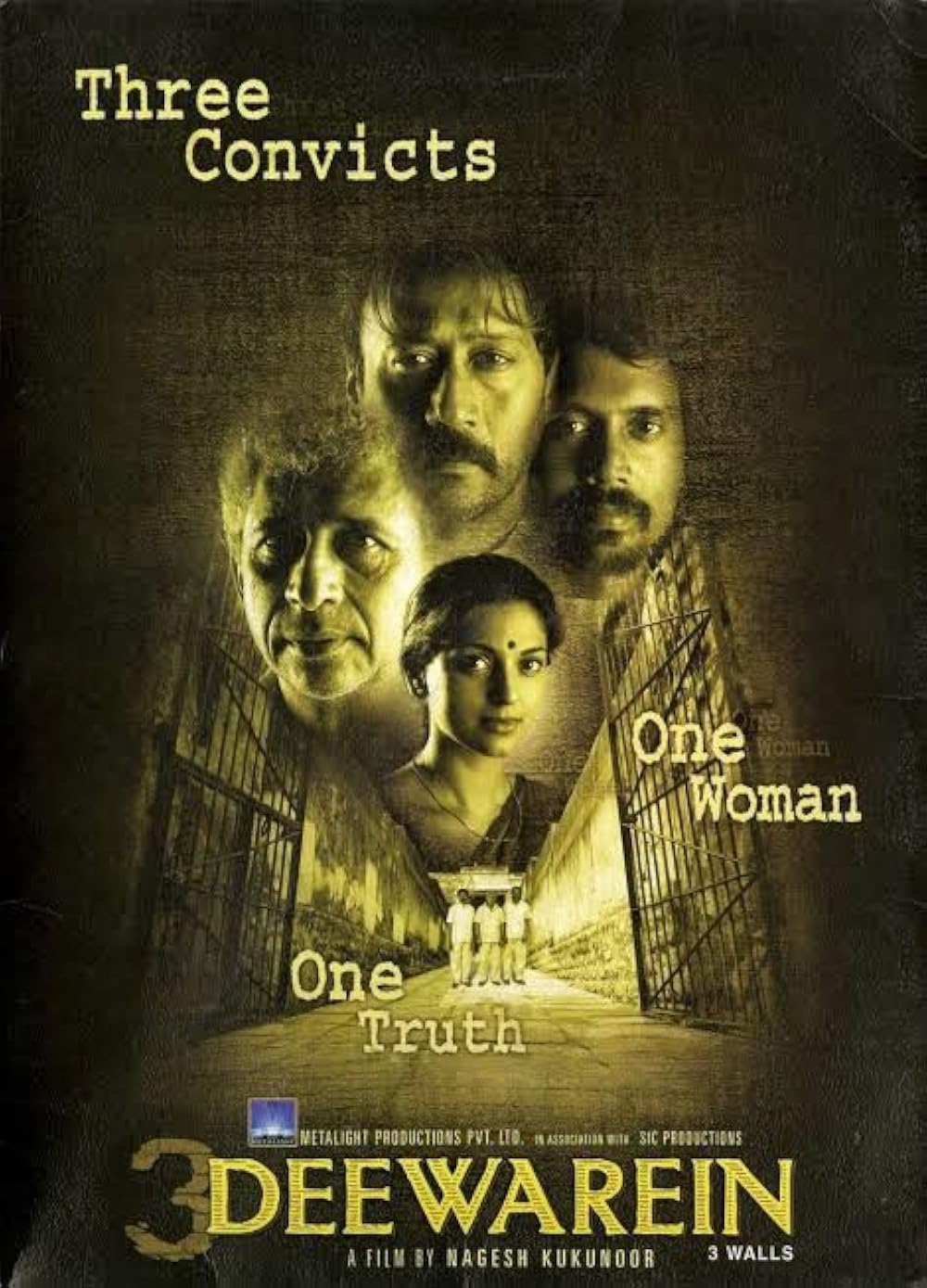
 Nagesh Kukunoor’s prison drama 3 Deewarein released on 1 August, 2003, is everything that you expect it to be—hardhitting, gritty, absorbing, real and raw—and then some more. The finale is so imposingly conceived you want to salute the director for simply taking the initiative of stretching the outer limits of mass-oriented entertainment.
For, make no mistake, 3 Deewarein isn’t a small arthouse film. Its vision of a prison is as grand as The Shawshank Redemption, though contrary to simplistic readings of Kukunoor’s intriguing jigsaw on life, death, and love, it doesn’t imitate a single moment from that famous Hollywood prison drama.
Kukunoor touches upon the theme of capital punishment without really making a central issue of the matter. His three heroes Ishaan(Naseeruddin Shah), Jaggu(Jackie Shroff), and Nagya(Nagesh Kukunoor) are on death row. More than their impending end, it’s their life that interests Kukunoor.
Having got satirical laughter out of himself, and us, in Hyderabad Blues and Bollywood Calling, Kukunoor spread his discernibly strong vision of human caprice and destiny’s damning jokes , across the theme of great power . 3 Deewarein is a prison story that had to be told. The characters, big or small, are so palpable in their pain; we feel their presence long after the film finishes.
The greatest gift that Kukunoor gives us is his perception of a full life. Desperate, anxious, and desolate his protagonists gather a glint of hope in their demeanour that spreads like a sheen of sunshine across this film’s seminal skyline.
Without dwelling on the metaphorical aspect of the jail tale, Kukunoor creates some stirring moments of pure cinema where poetry and parody flow in a free-flowing embrace of life and death.
Each of the three prisoner-heroes has his own murderous story to tell. By the time they are ready to spill the beans we’re completely hooked to their lives. The minute Juhi Chawla, playing a small-time filmmaker Chandrika, steps behind the prison walls, we know what’s in store, and yet by a perverse passion for predictability, we want more . Much more of that splendid mixture of life and death that pours out of the narrative in leisured tones.
Juhi Chawla’s character holds the key to the drama. As the Florence Nightingale who isn’t as frail and powerless as she (or we) initially believe her to be, Juhi makes you wonder where she’s been holding in that immense sensitivity and depth. In some sequences specially where her brutish screen husband (Shri Vallabh Vyas) abuses her, Juhi is a storehouse of reigned-in versatility. It would be criminal for Hindi cinema to lose this delicately potent actress to motherhood.
Kukunoor extracts first-rate performances from the whole cast. The three protagonists (Kukunoor included) get under the skin of their characters. Of course, as always, Naseeruddin Shah has a head start. His role is markedly more special than the others. Shah plays the smooth-talking jailbird as though he had lived in a prison cell all his life.
That , in so many cases, is true of every character. As Juhi interacts with her incarcerated subjects, she becomes conscious of her own life’s impregnable walls and how seriously she needs to break them. In her realization resides the film’s main strength.
The interactive drama among Juhi and her three prison friends is absorbing and cinematically astute. Just when we begin to applaud Kukunoor for his sensitive portrayal of shipwrecked lives, he drops a huge boulder of cinematic surprises on us.
The end-game where the narrative’s scattered sensations of crime and banishment come together in a neat bundle may seem over-clever, almost self congratulatory. But Kukunoor knows what he’s doing. Having brought his characters so close to our hearts, he doesn’t want to break them—the characters or our hearts.
The flamboyantly victorious finale is that corkscrew twist in this dazzlingly tormented tale to give a concluding vitality to lives that are frail but never pale. The colours of the prison are just that shade deeper than normal. Ajay Vincent’s cinematography is rich but never overdone.
The actors have seldom looked more vivid in their pain. As you watch them enshrined in their outer and inner prisons, you realize cinema needn’t be epic in canvas to scale the wall of greatness. 3 Deewarein is a remarkable piece of fictionalized life . It isn’t squeamish about life’s ugly truths(the scene where one of the gentler prisoners is raped by the HIV infected prison bully makes us flinch). But like Jaggu in the film, the director looks for poetry in the squalour of existence. And he finds it.
Speaking about his unexpected cast, Kukunoor says, “Juhi Chawla is strong. She was my first choice. When I was writing the script, she was the only actor I had in mind. She’s amazing. On the first day of shooting, she jokingly said, ‘You’re going to ruin my career because I’ve no idea what I’m doing.’ I snatched all references points from her. She learnt how much can be done with minimum expressions. She’s an instinctively brilliant actress. During rehearsals I’d say, ‘Oh my God!’ and she’d go, ‘What did I do?!’ When I was looking for someone to play the character Jaggu, I didn’t even know Jackie’s known as Jaggu. I was looking at some other actors for the role like Ajay Devgan. When I zeroed in on Jackie he wanted to know why I wanted him. I felt audiences had seen him long enough in a certain way. I wanted him to underplay to a ridiculous degree. Ishaan, whom Naseer finally played, was such a well-written role any competent actor could’ve carried off. He’s a character with so much gall. But Jaggu needed to be cast with more care. As for Naseer, I think after a long time he has come up with a performance as nuanced as this. And when people say he has only done the expected, it’s unfair to him. He busted his ass for the role. I thought of myself in the third protagonist’s role as the character grew in the script.”