
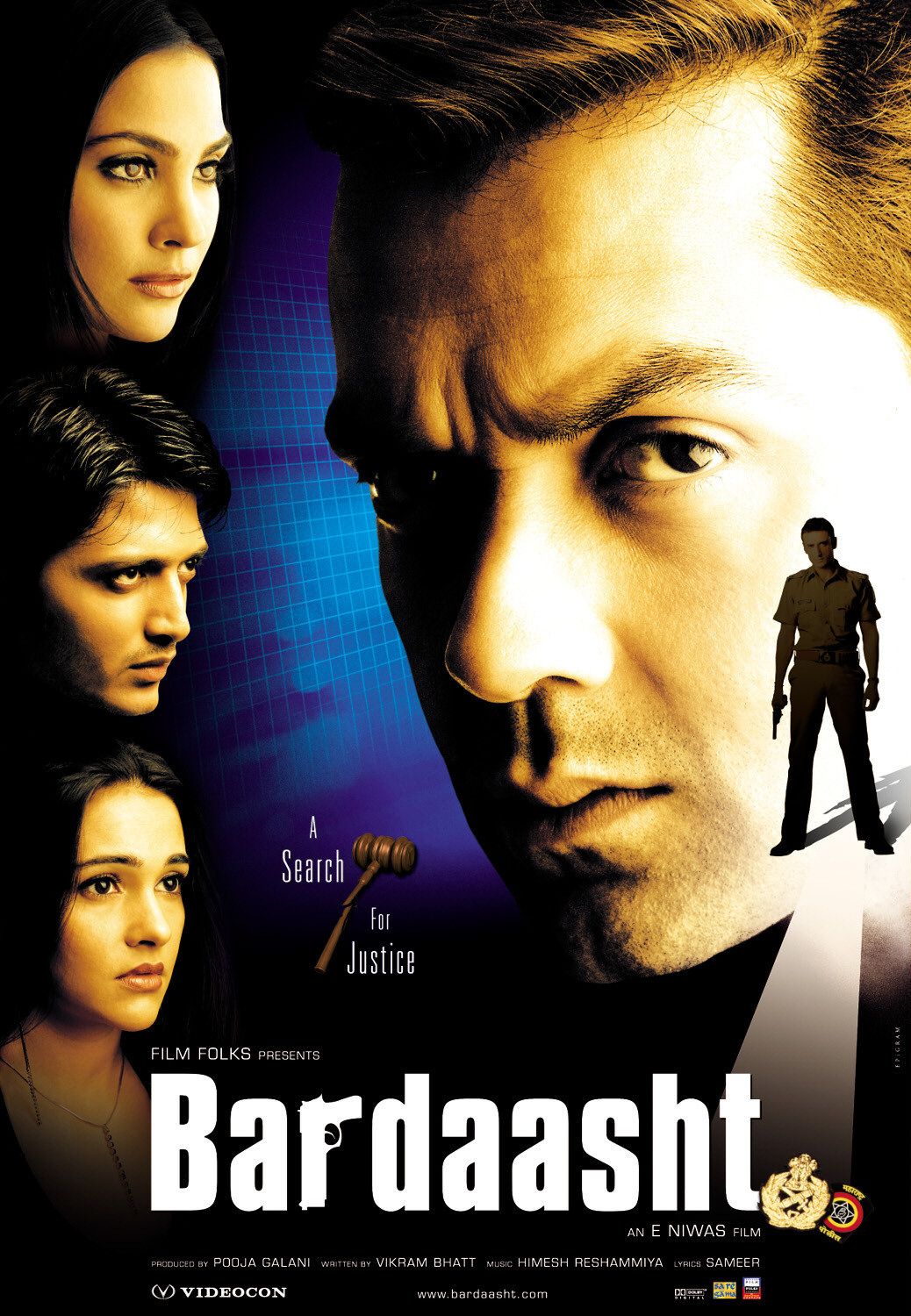
 Subhash K Jha looks back at Bobby Deol’s Bardaasht, which released in 2004. The drama, directed by Eeshwar Nivas and written by Vikram Bhatt, also featured Lara Dutta, Rahul Dev, and Ritesh Deshmukh.
It’s so easy to be cynical about a film with a title that is susceptible to amusing puns and jibes about testing the critics’ endurance. At a time when the film industry is busy assembling products showcasing cops as romantcized idealistic super-heroes Bardaasht takes a cynical view of the police force.
But the reality is this. Every day, law-abiding, God-fearing citizens are vulnerable to a taste of the en masse criminalization of the police force. Doing away with the wispy white-washing of the khaki uniform director E Niwas (in his third film on cops and cop-robbers after Shool and Dum) portrays the grim and gritty reality of the uneasy and often ruinous relationship between the ordinary citizen and the law enforcers.
Filmmaker Vikram Bhatt turns screenwriter to deliver what’s ironically his only original and by far the most riveting story ever. The leading man rises to the occasion. Bobby Deol drops his habitually langorous look and laidback demeanour to deliver a performance of substantial velocity. Almost every frame contains him. Deol makes the best of his silently simmering and suffering armyman-turned-civilian’s role.
As Aditya Shrivastava, Bobby is what his brother Sunny has repeatedly played in films like Arjun, Ghayal, etc. But Bobby gives the seething role his own spin. Unlike other tales of the civilian and the law, here Bobby doesn’t flex his muscles… until the astonishingly blotchy climax when, inexplicably, the director sets out to give his hero some belated ‘brawny’ points.
Most of the way, Bobby’s character is blessedly restrained and single-minded in his devotion to his wayward sibling, Anuj (Ritesh Deshmukh). The frantic desperation of a possessive guardian figure comes across in little gestures that convey the power of an implosive performance. The first overture of this, Bollywood’s first working-class thriller in ages, builds the protagonist’s idealistic character through his aborted tryst with the army and his comely girlfriend, Payal (Lara Dutta).
When Anuj disappears, Bardaasht becomes a kind of Citizen Kane on wheels, with Big Brother devoting his life to solving his beloved brother’s murder mystery.
As a director, E Niwas always keeps his narration simple. The camera (manned by Rakesh Manikantan) is as restrained in its movements as the protagonist, so that the audience gets ample leeway to absorb the narrative details. One wishes the director, valiant in his vision of life on the grim side, had shown the courage to do away with the songs.
The music of a lacerated soul in search of justice is mildly stirring. The sequence at the police station where Aditya tries to report his missing brother as the entire staff stays riveted to a cricket match, is an instant replay of all the films about social injustice since Mahesh Bhatt’s Saraansh, and yet moving because bureaucratic apathy(so effectively touched upon in Niwas’ earlier film Dum) cannot get outmoded …not in this country.
The distraught brother’s quest for justice is considerably coloured in the second half by reducing the wrongdoers to a trio of conniving villains (played by Rahul Dev and gang).To pin the blame on a small group of uniformed louts for the rot that has set into our system is as naïve as to blame cinema for social crimes. Nonetheless, the scene at the morgue with a callous attendant ridiculing Aditya’s grief is powerful in its impact.
Niwas restricts the thematic conflict to brotherly bonding. The absence of stereotypical humbug (Buffoon Cop, Item Song, etc.) gives the film a focused, serious look. The film’s single-mindedness of purpose collapses completely in the last half-hour when Bobby is made to do a Sunny Deol. The high-rise climax brings the narration crashing down and exposes the director’s failure to stay within the working-class ambit he builds earlier on.
On the plus side, the romance is sensibly knit into the plot by making Lara Dutta a part of the main conflict. As a lawyer, Lara delivers her lines with luscious conviction. You wish there was more of her. Rahul Dev is a terrifying adversary, though not half as menacing as the evil cop that Atul Kulkarni played in Niwas’ Dum. Ritesh Deshmukh’s Anuj is as much the ubiquitous soul of the plot as Daphne du Maurier’s Rebecca. The character breathes life into the goings-on through his death.
There are two interesting cameos by Veerendra Saxena (as a conscientious havaldar) and Tara Sharma, as the dead Anuj’s traumatized girlfriend. Sharma, so far a disaster in all her roles, is a nervy revelation.
Just goes to show, actors are as good or bad as the director and script. And though Bardaasht doesn’t really say or do anything new, it projects social reality with a sense of restrain and responsibility which generate a ripple of empathy in us. Most of all, the film signals Bobby Deol’s coming-of-age as an actor.