
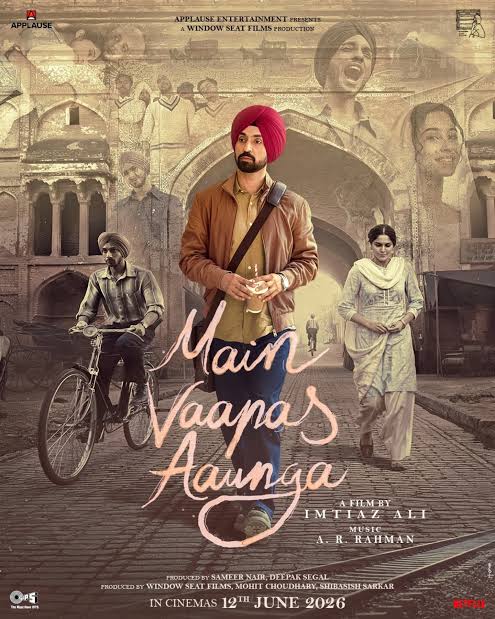
Main Vaapas Aaunga
Starring: Diljit Dosanjh, Naseeruddin Shah, Vedang Raina, and Sharvari
Directed by Imtiaz Ali
It is no coincidence that Imtiaz Ali chooses not to rely on coincidences when he really needs to. This comes at the closure point of this lengthy, luminous, demanding, at times frustrating journey into the wounds of the Partition.
Diljit Dosanjh playing Naseeruddin Shah’s adrift NRI grandson Nirvair tells a character, “So what if this is a coincidence? Such things do happen in life.”
Maybe they do. But not here. Not in this film. Main Vaapas Aaunga never chooses the easy way out. It is not a smooth journey for the characters, or for their perpetrator. Imtiaz Ali loves to swim against the tide. Here, he is neck-deep in troubled muddy waters, unable to breathe at times, but determined to tell his Partition story, a love story and one quite contrary to the Veer Zaara stereotype of love across the border, although the external resemblances to the two love sagas are not to be missed.
Imtiaz Ali’s cry for peace transcends the love story at the centre of the plot. I am not sure the director has been able to tell the story exactly the way he imagined it. There are times when the narration feels wobbly. But the heart is never wrong. This is a story of crossing borders, the geopolitical and emotional, in search of closure.
The closer the narrative gets to that closure, the less inclined Imtiaz is to spoonfeed our audience with the kind of elementary drama that defines commercial cinema. The film LOOKS like a mainstream product, but in reality, it eschews all the rules of the genre, opting to go so far away from the humdrum that we often miss the beat of the drums to which the narrative walks so defiantly.
Pertinently, the characters speak the language of their hearts, so undiluted and unsimplified that the regular punctuation and syntax of commercial Hindi cinema are completely transformed, if not erased. When a 95-year-old dying patriarch mumbles about Mars, Martians, and the moon, we are not given a translation. We are not given the easy way out.
The language of the film is unadorned, and all the more beautiful for it. The absence of affectations goes a long way in making this a deeply satisfying exploration of the wounds which never heal, of being rendered homeless even if death is preferable.
While the absence of an even pacing, leading to respiratory complications more serious than the dying patriarch’s, is a major problem, there is so much to absorb in the details, we tend to ignore the languorous progression from crisis to closure.
Diljit Dosanjh’s unanchored character, a terrible stand-up comedian who evolves as a grieving grandson in Chandigarh into quite an audience holder, is the best possible metaphor for what Imtiaz Ali leaves unsaid: life teaches us to treat the failures as a means to unlearn the wrongs and better ourselves.
Dosanjh is terrific, right to the end when he sings a peace anthem in the midst of the rubble of war (a bit too much of hitting the roof). Naseeruddin Shah plays the incoherent dying man with exceptional coherence, his eyes the mirror of pain and guilt.
From among the supporting cast, Rajat Kapoor is excellent as Shah’s harried son.
But the real scene-stealer is Vedang Raina as the younger version of Naseer, courting Sharvari with a disarming diffidence, his eyes communicating love and fear sometimes together, mostly apart.
Main Vaapas Aaunga is not a breezy experience. It commands our attention and respect for constructing a compelling case for peace and empathy at a time when movies are going all-out to propagate hatred and enmity. What Imtiaz Ali asks us in this precious film about love and amity is this: could the enemy be within us?